By Sherman G. Mohr, Founder of Over50Pros
Empowering the Second Act Workforce
Let’s address the exhaustion you’re feeling. You built your freelance practice on reliability, on being the person who delivers, on never turning down work. That work ethic built your reputation. However, it’s now threatening to dismantle your sanity. The phone buzzes at 9 PM with a “quick question.” A client adds “one small thing” that balloons into three hours of unbilled labor. Another expects weekend responses because you replied once on a Saturday last month. You’re busy—but you’re also burning out.
Here’s the uncomfortable truth: saying yes to everything isn’t professionalism. It’s self-sabotage. According to AARP research, over 74% of workers over 40 are actively seeking ways to reduce work-related stress, and more than half report experiencing burnout severe enough to impact their wellbeing . The solution isn’t working harder; it’s learning when to say no: red flags and boundary scripts that protect both your reputation and your peace of mind. Your experience has earned you the right to be selective. Now, you need the tools to exercise it.
The Galloway Lens: No Is a Strategy, Not a Rejection
Professor Scott Galloway frames boundaries through the lens of brand management: “Every time you say yes to the wrong client, you’re saying no to the right one. Your time is your most finite asset. It’s also your only inventory. Protecting it isn’t selfish; it’s strategic. The most successful professionals understand that ‘no’ is a complete sentence. It signals scarcity, which signals value. When you’re endlessly available, you communicate that your time has no premium. When you’re selectively accessible, you communicate that your expertise is worth protecting.”
This reframing is essential. Boundaries don’t limit your growth—they enable it. The right clients respect limits. The wrong ones reveal themselves precisely by how they react to them.
The Five Red Flags: When Your Gut Is Trying to Protect You
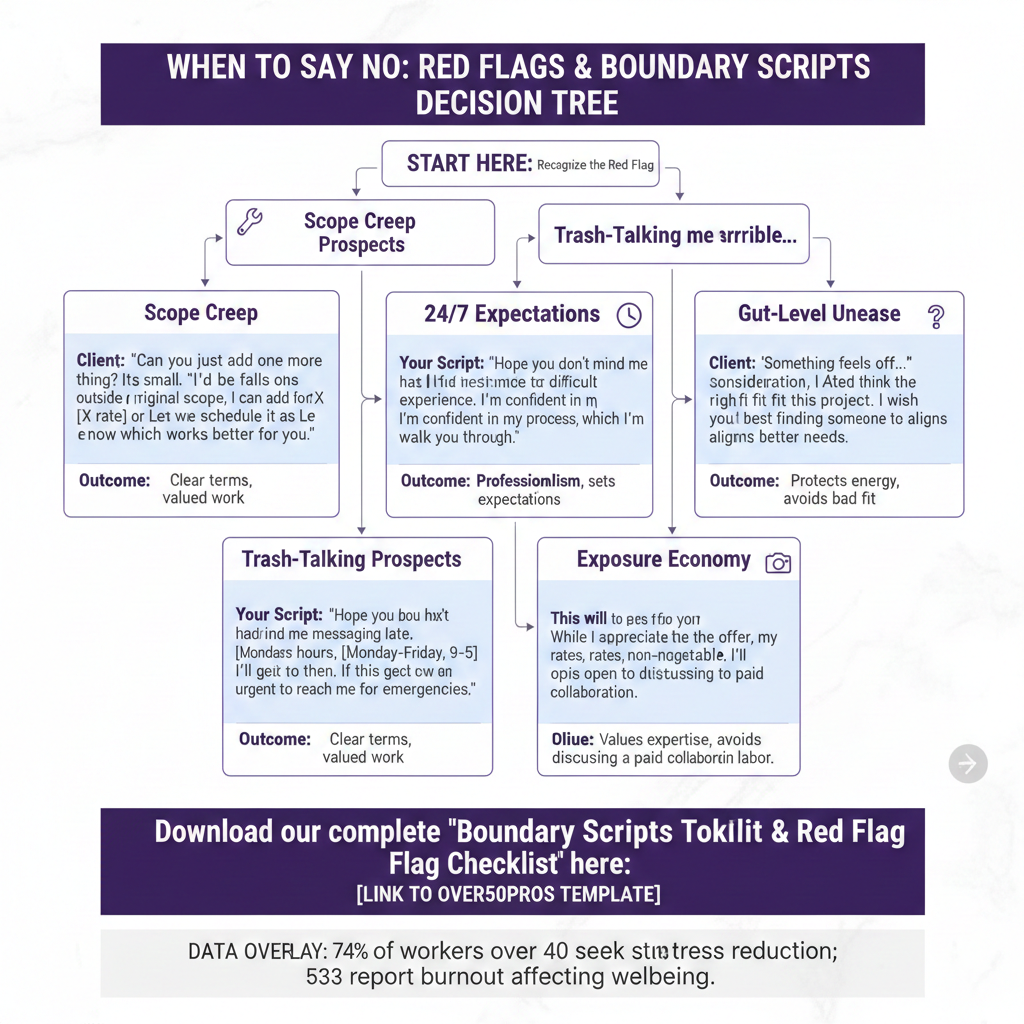
Before scripts matter, recognition matters. Here are the non-negotiable warning signs that should trigger your boundary reflexes. Each one appears consistently across Reddit gig threads and freelancing forums as the precursor to regret .
Scope Creep Disguised as Flexibility
The job description arrives fuzzy. “Just a few quick updates.” “Nothing complicated.” This vagueness isn’t innocent—it’s a trap. Clients who cannot define scope upfront will expand it endlessly mid-project. What begins as a single revision becomes five. A “quick” consult becomes weekly unpaid strategy sessions. The pattern isn’t malice; it’s ignorance of how much hidden work sits inside each request. However, ignorance doesn’t pay your bills.
The Trash-Talking Prospect
A potential client spends the first conversation criticizing every previous freelancer they’ve hired. “No one reliable anymore.” “The last person completely missed the brief.” “I had to fire someone just last month.”
Listen carefully. In every such story, the common denominator is the storyteller. These clients don’t have bad luck; they have bad patterns. You will not be the exception. You will simply become the next chapter in their anthology of disappointment.
The 24/7 Availability Expectation
Messages arrive at midnight. Emails stack up over weekends with “urgent” flags. There’s an implicit assumption that because you work independently, you’re always working. This erodes not just your schedule but your identity. You stop being a professional with a life and become a service appliance expected to run continuously.
The Exposure Economy
“Great exposure.” “Portfolio builder.” “We’ll send lots of referrals your way.” These phrases translate to: “I want your expertise but don’t want to pay for it.” Exposure doesn’t cover your healthcare premiums. Referrals don’t buy groceries. Value yourself accordingly.
The Gut-Level Unease
Sometimes, no single flag appears. Instead, there’s a cumulative discomfort you can’t quite articulate. The tone feels slightly off. The answers come too slowly or too evasively. Something doesn’t align.
Trust this. Your instincts are built on thousands of previous interactions your conscious mind can’t individually recall but collectively recognizes. When something feels wrong, it usually is .
Boundary Scripts: What to Say and How to Say It
For Scope Creep
Client: “Can you just add one more thing? It’s small.”
Your Response: “I’d be happy to handle that. Since it falls outside our original scope, I can add it for [X rate] or we can schedule it as a separate project. Let me know which works better for you.”
This response does three things: acknowledges the request, validates your boundaries, and offers choice. It’s not defensive; it’s professional.
For Unrealistic Deadlines
Client: “We need this by tomorrow. Can you make it work?”
Your Response: “To deliver the quality you expect, I’ll need until [revised date]. If it’s truly urgent, I can prioritize it with a rush fee of [X]. Let me know how you’d like to proceed.”
Notice what’s missing: apology. You’re not sorry for needing reasonable time. You’re protecting your reputation by refusing to deliver rushed, substandard work.
For After-Hours Communication
Client: “Hope you don’t mind me messaging late. Just had a thought.”
Your Response: “I check messages during business hours, [Monday-Friday, 9-5]. I’ll get back to you then. If this is urgent, here’s how to reach me for emergencies.”
This establishes that you have boundaries without punishing the client for crossing them. Most will respect the clarity.
For Late Payment Patterns
Client: “Invoice? Oh, I’ll get to it when I can.”
Your Response: “My payment terms are spelled out in our agreement. I’m happy to resend the invoice, but I’ll need to pause current work until payments are brought current.”
Firm. Clear. Non-negotiable. Clients who respect you pay on time.
For the Full Decline
When you simply need to walk away:
Your Response: “After consideration, I don’t think I’m the right fit for this project. I wish you the best finding someone who aligns better with your needs.”
No over-explaining. No justification invitation. Just clean closure.
Why Clients Actually Respect Boundaries
Here’s what experienced freelancers discover: the clients who react poorly to reasonable boundaries were never going to be good clients. They reveal themselves precisely through that reaction. Conversely, the clients worth keeping respond with respect—sometimes even with relief.
One Over50Pros community member, a former marketing executive turned fractional CMO, shared this: “I used to answer emails at all hours because I thought it showed dedication. When I finally set working hours and communicated them clearly, not a single good client complained. Several actually thanked me. They said it helped them structure their own expectations and respected that I had a life beyond their inbox.”
Boundaries function as filters. They repel the draining and attract the respectful. Your job isn’t to accommodate everyone; it’s to create conditions where quality work can flourish.
The Grandfather Clause on Availability
If you’re transitioning from “always available” to “reasonably accessible,” consider a transition period. Communicate the change clearly and with advance notice:
“Starting next month, I’m adjusting my availability to better serve my clients with focused, uninterrupted work. My new response hours will be [X]. I’m committed to making this transition smooth and will continue delivering the quality you expect.”
This communicates that boundaries aren’t punishment; they’re an upgrade to your service model.
From Burnout to Sustainable Success
Ultimately, mastering when to say no: red flags and boundary scripts transforms your practice from reactive to intentional. You stop being a resource to be depleted and become a partner to be valued. Your experience isn’t just about what you can do—it’s about what you choose to do, and with whom.
The clients who respect your boundaries are the ones worth keeping. The work that honors your limits is the work that sustains you. And the career you build on selective, intentional commitments is the one that will carry you through your second act with energy intact.
If you’re over 50 years old and ready to protect your time, your sanity, and your reputation while building a sustainable gig practice, start by knowing which opportunities deserve your yes. Take our free assessment at https://over50pros.com. The results will deliver your top three gig options aligned with your experience and values. You’ll see fairly priced courses—including our comprehensive Boundaries & Client Communication workshop—designed to get you prepped for a balanced, profitable gig economy career.
For more information, resources, and inspiration, subscribe to our weekly newsletter. We call it “The Front of the Check”.
We feel all people need to take control over their own futures. The newsletter will help you do it! Subscribe here! (Hotlink Subscribe here!) with https://frontofthecheck.com