By Sherman G. Mohr, Founder of Over50Pros
Empowering the Second Act Workforce
Let’s be honest. You’ve heard them. Perhaps recently. Perhaps from a promising prospect who seemed genuinely interested—until that moment. “You’re too expensive.” Four words that can deflate confidence, trigger self-doubt, and tempt even seasoned professionals to discount. But here’s what experienced pros understand: Handling “You’re Too Expensive” Objections isn’t about lowering prices. It’s about elevating the conversation. According to sales coaching research, 57% of prospects who raise price objections are actually expressing uncertainty about value, not inability to pay . They’re not saying “I can’t afford you.” They’re saying “I haven’t yet understood why you’re worth it.” This distinction changes everything.
The Galloway Reframe: Price Is Never the Real Objection
Professor Scott Galloway addresses pricing anxiety with characteristic directness: “When a client says ‘you’re too expensive,’ they’re not making a statement about your price. They’re making a statement about your perceived value gap. They’re saying the spread between what you charge and what they believe they’ll receive is too wide. Your job isn’t to narrow that gap by dropping price. Your job is to widen their perception of value. Handling ‘You’re Too Expensive’ Objections requires shifting from cost defense to value articulation. Amazon doesn’t discount when someone complains about shipping fees. They accelerate delivery. You don’t lower rates when someone questions value. You illuminate outcomes.”
This reframe is liberating. The objection isn’t a rejection; it’s a request for more information. The prospect is essentially asking, “Help me understand why this investment makes sense for me.”
The Empathy First Framework
Before deploying any script, establish emotional connection. Prospects raising price objections often feel vulnerable. They worry they can’t afford quality. They fear being upsold. They’ve been burned by overpromisers.
Consequently, your first response should validate, not defend.
Step One: Acknowledge Without Apology
“Thank you for sharing that honestly. I appreciate your transparency, and I want to make sure you feel confident about any investment you make.”
Notice what this accomplishes. You’ve thanked them for candor, creating safety. You’ve reframed “expense” as “investment,” introducing value language. You’ve aligned yourself with their interest in confidence, not just closing.
Step Two: Explore Without Interrogating
“Help me understand what you’re comparing my quote against. Is this a budget consideration, or are you seeing different pricing elsewhere?”
This open-ended question reveals the objection’s true nature. Are they budget-constrained? Have they received lower quotes? Do they simply not understand your differentiation? Each answer demands a different response strategy.
The Value Illumination Script
Once you understand the objection’s source, deploy targeted value evidence.
If they’re comparing to lower quotes:
“I understand other providers may offer lower rates. May I share what typically accounts for the difference? My approach includes [specific differentiator: insurance, guarantees, specialized expertise, follow-up support]. For clients who’ve chosen lower-cost options, I’ve often heard they ended up spending more on fixes or replacements. My goal is getting it right the first time.”
If they’re budget-constrained:
“I respect that budgets matter. Rather than compromising on scope, might we explore phasing the work? We could address your highest priority now and schedule remaining elements when it’s more comfortable. This way you still receive my full approach without stretching today.”
If they’re uncertain about value:
“Would it be helpful if I shared examples from similar clients who initially had the same concern? [Pull up social proof album.] Here’s a project very similar to yours. The client was hesitant initially, but here’s what they said afterward [read testimonial]. My goal isn’t just completing work; it’s delivering outcomes that make the investment feel small compared to the value received.”
The Social Proof Pivot
Here’s where your Handling “You’re Too Expensive” Objections arsenal becomes most powerful. When prospects express price concerns, they’re often seeking reassurance that others like them made this choice and felt good about it.
Consequently, your social proof album becomes your greatest ally. Before prospects commit, let your past clients advocate for you.
The Testimonial Sandwich Technique:
- “I understand your hesitation about the investment.”
- [Show before image] “This client had the same concern last year.”
- [Show after image] “Here’s what we accomplished together.”
- [Read testimonial] “And here’s what they said afterward: ‘Worth every penny. I wish I’d done it sooner.'”
- “My approach isn’t for everyone. It’s for clients who value getting it right the first time.”
This sequence doesn’t argue about price. It demonstrates value through undeniable visual evidence and authentic peer validation.
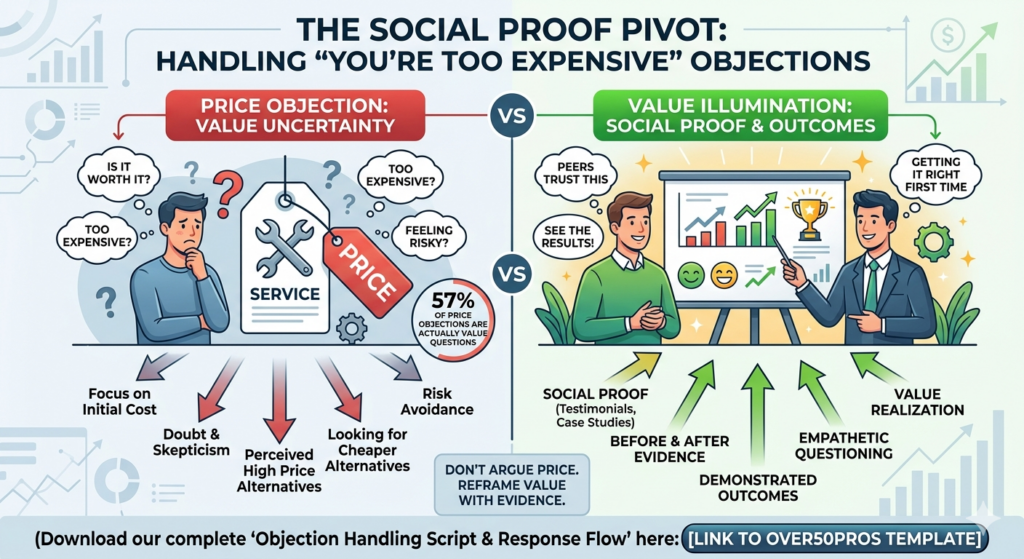
The Discount Trap: Why It Costs More Than You Think
When faced with “you’re too expensive,” discounting feels like the path of least resistance. However, freelance negotiation research reveals a troubling pattern: clients who receive discounts are statistically less satisfied, more demanding, and less likely to provide referrals than full-price clients .
Why? Because price signals value. When you discount, you unconsciously communicate that your original price was inflated. You train clients to negotiate every future engagement. You attract price shoppers rather than value seekers.
Moreover, discounting disproportionately affects professionals over 50. Your experience commands premium rates. Discounting erodes decades of accumulated expertise, positioning you as a commodity rather than a specialist.
The Strategic Alternative: Value-Add, Not Price-Cut
If a client genuinely cannot meet your rate but feels like the right fit, consider value-adds rather than discounts:
- Extended payment terms without interest
- A slightly reduced scope at full rate
- Bundled future services at today’s pricing
- Referral credits applied after completion
Each option preserves your rate while demonstrating flexibility. Each communicates that your time has value, but you’re willing to structure creatively.
The Confidence Compound
Here’s what experienced pros discover: Handling “You’re Too Expensive” Objections becomes easier with practice—not because clients stop objecting, but because your confidence grows. Each successfully navigated objection reinforces that your value is real, your expertise is稀缺, and your rates reflect decades of refined capability.
One Over50Pros community member, a former HR executive turned career coach, shared this insight: “The first time someone said I was too expensive, I almost halved my rate on the spot. I didn’t. I used the script, showed testimonials, and stayed calm. They booked at full price. Now when I hear ‘too expensive,’ I actually get excited. It means they’re interested enough to engage, and I get to practice my craft.”
The Ultimate Objection Handler: Your Track Record
Ultimately, the most persuasive response to any price objection is your track record. Every satisfied client, every documented transformation, every testimonial praising your work constitutes evidence that your rates represent value, not expense.
Consequently, your most important pre-work happens before any objection arises. Document everything. Curate your proof. Practice your scripts. Know your numbers. When you believe in your value completely, that belief becomes contagious.
If you’re over 50 years old and ready to transform price objections into booked engagements, start by understanding your unique value proposition. Take our free assessment at https://over50pros.com to discover your top three gig economy opportunities—roles where your specific expertise commands premium rates. Then explore our fairly priced courses on value-based pricing, client communication, and objection handling, designed specifically for professionals building their Second Act Advantage.
For more information, resources, and inspiration, subscribe to our weekly newsletter. We call it “The Front of the Check”.
We feel all people need to take control over their own futures. The newsletter will help you do it! Subscribe here! (Hotlink Subscribe here!) with https://frontofthecheck.com