By Sherman G. Mohr, Founder of Over50Pros
Empowering the Second Act Workforce
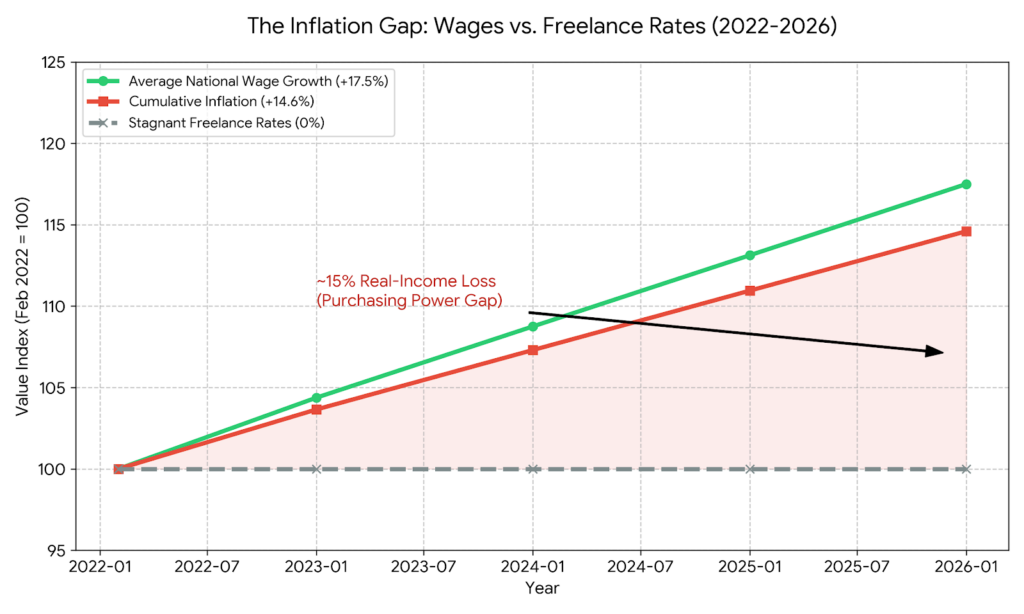
Let’s begin with an uncomfortable math problem. If you charged $65 per hour in 2022 and haven’t changed your rates since, you’re not standing still—you’re going backward. The Bureau of Labor Statistics reports that the Consumer Price Index (CPI) rose from 283.7 in February 2022 to 325.3 in January 2026, representing a cumulative inflation increase of approximately 14.6% . Consequently, your $65 now buys what $55 bought four years ago. You’ve absorbed a 15% pay cut through silence alone.
This isn’t a criticism; it’s a wake-up call. For experienced professionals over 50, pricing with inflation in mind isn’t greed—it’s survival arithmetic. Yet most freelancers never adjust. According to freelance pricing experts, if you haven’t raised your rates in 12 months, you didn’t stay the same—you took a pay cut . Your skills have sharpened. Your processes have streamlined. Your outcomes have improved. Your pricing should reflect this trajectory.
The Galloway Doctrine: Inflation Is a Tax on Complacency
Professor Scott Galloway frames this reality with characteristic directness: “Inflation is often discussed as a macroeconomic phenomenon, something that happens to us. This is passive thinking. In reality, inflation is a tax on complacency. The market reprices everything annually—labor, materials, capital. If you’re not repricing your own expertise, you’re subsidizing your clients at your own expense. Pricing with inflation in mind isn’t about keeping up; it’s about capturing the value you actually deliver. Your client’s budget for this service increased with inflation. Why shouldn’t your share?”
He’s right. The same economic forces that raised your grocery bill also raised what clients expect to pay for quality work. The question isn’t whether to adjust; it’s how to adjust strategically.
The Inflation Impact: By the Numbers
Let’s ground this in data. Average hourly earnings for private workers rose from $31.64 in February 2022 to $37.17 in January 2026—a 17.5% increase . Wages have slightly outpaced inflation nationally. But here’s the catch: those are employee wages with built-in annual reviews and cost-of-living adjustments. Freelancers don’t receive automatic raises. We must initiate them ourselves.
Meanwhile, the personal savings rate has plummeted from 6.3% in early 2022 to just 3.6% by late 2025—a 43% drop . This means households are stretching thinner, but importantly, they’re still spending. They’re just spending more strategically. Quality becomes the differentiator when budgets tighten.
The Annual Review Framework: Your New Non-Negotiable
Here’s the system that protects your real income year after year. Top freelancers recommend reviewing rates at least once annually, with standard increases of 10-15% as skills, efficiency, and portfolio quality improve . The key is consistency. Annual small increases face far less resistance than sudden large jumps.
Step One: The Data Gathering (30 Days Out)
Begin by consulting the latest CPI data. The February 2026 report showed headline inflation at 2.4% year-over-year, with core inflation at 2.5% . This provides your baseline floor. However, don’t stop at inflation. Add a premium for your increased expertise. If you’ve completed relevant certifications, streamlined your delivery time, or added new services, these justify increases above the inflation rate.
Step Two: The Grandfathering Strategy
When communicating changes, give existing clients 30-60 days notice. Reference the value delivered over your working relationship. If appropriate, grandfather them at current rates for a transition period . This preserves goodwill while establishing your new baseline. New clients receive the increased rate immediately—no exceptions.
Step Three: The Communication Template
Here’s a proven email framework adapted from freelance pricing experts :
Subject: Update to service rates for 2026
Hi [Client Name],
*I hope you’re having a great start to the year. I’m writing to share an update to my rate structure. Effective [Date+30 days], my rate for [Service] will be [$X].*
I’ve really enjoyed working with you on [Project] this past year, and I wanted to give you plenty of notice before this takes effect. This adjustment reflects both inflationary changes in the economy and the enhanced value I’m now able to deliver through [briefly mention improved skills/processes].
Let me know if you have any questions!
Notice what’s absent: apologies, excessive justifications, or defensiveness. This is business. Good clients expect annual adjustments and often budget for them .
Beyond Hourly: The Scope Reduction Alternative
Sometimes a client genuinely cannot meet your increased rate. In these situations, avoid discounting. Instead, reduce scope while maintaining your rate . This approach protects your effective hourly earnings while keeping the client relationship intact.
For example, if a client’s budget is $800 and your quote was $1,200, propose removing specific deliverables to fit their budget. Fewer articles, shorter word counts, limited revisions—these adjustments keep your rate intact while meeting their financial constraints . This frames you as a collaborative problem-solver rather than an inflexible vendor.
Why Experienced Pros Hesitate—And Why We Must Stop
Let’s name the fear: losing clients. Research confirms that most long-term clients accept reasonable annual increases (10-15%) because finding and onboarding a replacement freelancer costs more than the rate difference . The clients most likely to leave over modest increases were often your most demanding, lowest-margin relationships anyway. Price increases function as a natural filter, retaining those who value outcomes over hourly cost.
One Over50Pros community member, a former project manager turned consulting specialist, shared this: “I raised rates 12% in January. Lost one small client. Gained two better ones within weeks, and my remaining clients started treating me like a professional rather than a helper.” This pattern repeats consistently across service industries.
The 2026 Opportunity
Current economic signals point to continued moderation in inflation. The January 2026 CPI reading of 0.2% monthly increase fell below historical January averages, suggesting underlying pressures are genuinely moderating . This creates an ideal environment for strategic rate adjustments—the macroeconomic turbulence is calming, allowing your value proposition to take center stage.
Pricing with inflation in mind isn’t a one-time exercise. It’s an annual discipline, like equipment maintenance or tax preparation. Schedule it. Execute it. Move forward.
From Erosion to Expansion
If you’re over 50 years old and ready to ensure your experience commands its full value in today’s economy, begin with accurate data about your earning potential. Take our free assessment at https://over50pros.com to discover your top three gig economy opportunities—roles where your specific expertise commands premium rates. Then explore our fairly priced courses on value-based pricing and client communication, designed specifically for professionals building their Second Act Advantage.
For more information, resources, and inspiration, subscribe to our weekly newsletter. We call it “The Front of the Check”.
We feel all people need to take control over their own futures. The newsletter will help you do it! Subscribe here! (Hotlink Subscribe here!) with https://frontofthecheck.com