By Sherman G. Mohr, Founder of Over50Pros
Empowering the Second Act Workforce
Let’s start with a painful statistic. According to Harvard Program on Negotiation research, experienced professionals leave an average of 20-30% of potential income on the table simply by accepting the first offer or avoiding negotiation altogether. For a gig worker earning $60,000 annually, that’s $12,000 to $18,000 in lost revenue every single year. Not because they lack skill. Not because they lack experience. But because they lack the specific language to convert that experience into higher rates. Rate Negotiation Scripts That Leverage Experience bridge this gap. They transform your decades of accumulated wisdom from an abstract asset into a concrete justification for premium pricing. Your expertise isn’t just relevant—it’s your most powerful negotiation tool.
The Galloway Frame: Experience Is Intellectual Property
Professor Scott Galloway dismantles the fear of negotiation with characteristic clarity: “Younger workers negotiate based on potential. They say, ‘Hire me and see what I become.’ You negotiate based on proof. You say, ‘Hire me and see what I’ve already done for people exactly like you.’ This is an infinitely stronger position. Your Rate Negotiation Scripts That Leverage Experience don’t ask for favors; they demand fair exchange for demonstrated capability. When you hesitate to negotiate, you’re not being humble—you’re devaluing your own intellectual property. Would Apple discount the iPhone because the buyer seemed nice? No. Neither should you.”
This reframing is essential. Negotiation isn’t confrontation; it’s clarification. You’re helping the client understand the full value of what they’re about to receive.
The Three Foundational Scripts
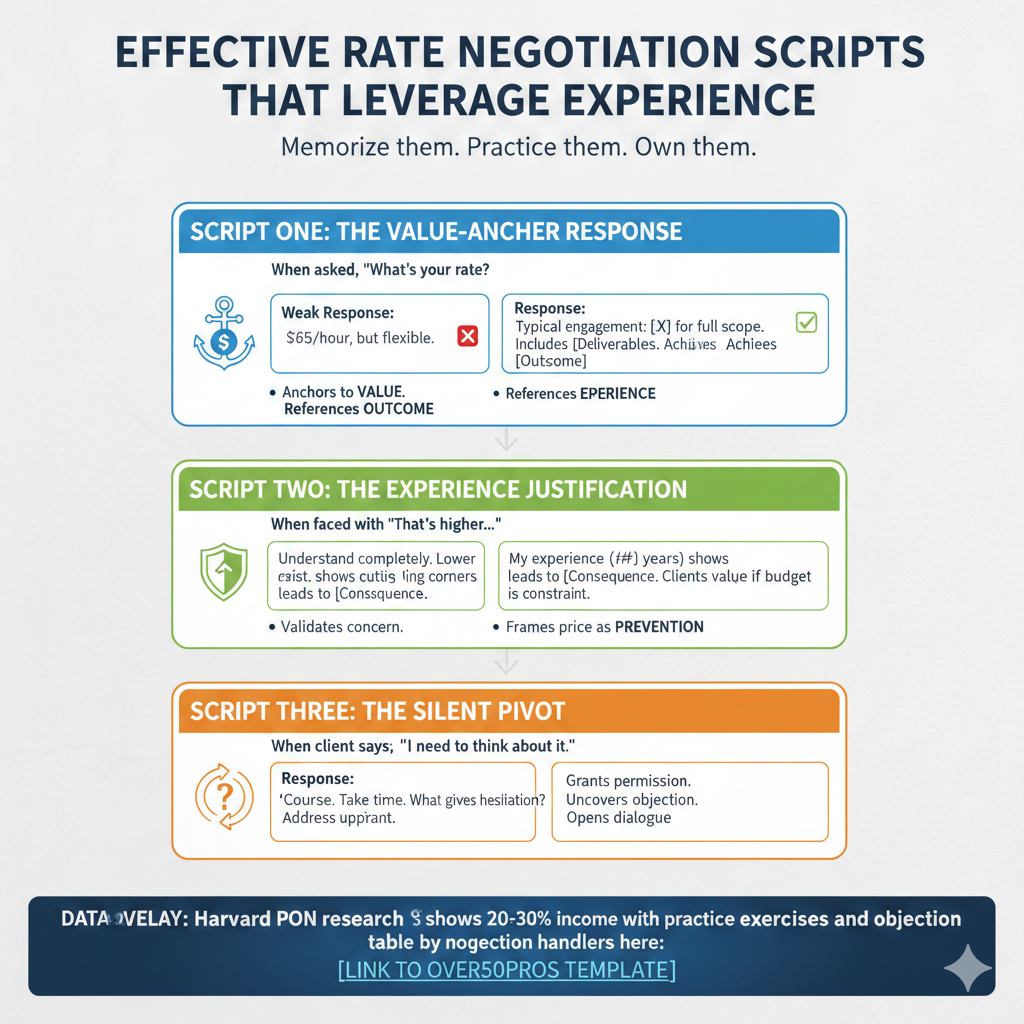
Effective Rate Negotiation Scripts That Leverage Experience fall into three categories. Memorize them. Practice them. Own them.
Script One: The Value-Anchor Response
When a prospect asks, “What’s your rate?” before understanding your value.
Weak response: “I usually charge $65 an hour, but I’m flexible.”
Strong response: “For clients with needs similar to yours, my typical engagement runs [$X] for the full scope. That includes [mention 2-3 specific deliverables rooted in your experience]. Based on our conversation, I’m confident we can achieve [specific outcome] within that framework.”
Why it works: You’ve anchored to value, not hours. You’ve referenced similar clients (experience). You’ve promised an outcome. The conversation shifts from “Can I afford you?” to “Can you deliver what I need?”
Script Two: The Experience Justification
When a prospect balks, saying, “That’s higher than others I’ve spoken with.”
Response: “I understand completely, and you absolutely can find capable people at lower rates. What my experience has shown me—across [number] years of doing this—is that cutting corners on [specific aspect of the work] almost always costs more in the long run through [specific consequence: rework, delays, missed opportunities]. My clients consistently tell me they value the peace of mind that comes from knowing it’s done right the first time. If budget is genuinely a constraint, I’m happy to discuss a modified scope that protects your must-haves.”
Why it works: You’ve validated their concern. You’ve distinguished yourself from competitors without insulting them. You’ve offered a graceful path forward while holding your rate. Most importantly, you’ve framed your price as prevention rather than expense.
Script Three: The Silent Pivot
When a prospect says, “I need to think about it,” and you sense stalling.
Response: “Of course. Take the time you need. While you’re considering, may I ask what specifically gives you hesitation? Sometimes I find that addressing a concern upfront saves everyone time.”
Why it works: You’ve granted permission to pause while gently uncovering the real objection. Often, “I need to think” means “I’m uncomfortable with the price but don’t want to say so.” This script opens that door politely.
Practice Protocol: From Scripts to Second Nature
Reading scripts is useless. Internalizing them through deliberate practice is everything.
The Mirror Method: Stand before a mirror and deliver each script aloud. Watch your facial expressions. Do you look apologetic? Confident? Terrified? Adjust until your nonverbal communication matches your words. Negotiation is 70% delivery, 30% content.
The Partner Practice: Recruit a fellow Over50Pros member or trusted friend. Have them play the difficult client. Practice until the scripts feel like conversation rather than recitation. Record these sessions if possible. Listen for verbal tics (“um,” “like,” “I guess”) that undermine authority.
The Real-World Warm-Up: Before negotiating a high-stakes engagement, practice on smaller opportunities. A one-time project. A potential client you’re ambivalent about. These low-pressure negotiations build muscle memory for when it matters most.
The Objection You’ll Hear Most Often
“I really like you, but I found someone cheaper.”
This is the classic age-related objection disguised as a budget concern. Here’s your response, calibrated for your demographic:
“I appreciate your honesty, and I genuinely hope that works out well for you. What I’ve learned over the years is that ‘cheaper’ and ‘better value’ are rarely the same thing. My clients typically find that paying a bit more upfront for someone who truly understands [their industry/their challenges/their timeline] saves them significant money on the back end. If your situation changes and you decide predictability matters more than price, I’d welcome the opportunity to help.”
No defensiveness. No price matching. Just dignified positioning that leaves the door open while establishing your worth.
The Psychology of “No”
Here’s what experienced negotiators understand: the word “no” is not a rejection of you. It’s a rejection of a specific proposal at a specific moment. Sometimes it’s permanent. Often it’s temporary. Occasionally it’s a test.
When a client says no to your rate, they’re saying:
- “I don’t fully understand your value yet.”
- “I’m not convinced the outcome justifies the investment.”
- “I need permission from someone else.”
- “I’m hoping you’ll discount.”
Your job isn’t to argue. Your job is to diagnose which “no” you’re hearing and respond accordingly. The scripts above address each variation.
From Anxiety to Authority
Ultimately, Rate Negotiation Scripts That Leverage Experience do more than increase your income. They transform your professional identity. Each successful negotiation reinforces that your experience has value, polite, confident conversation builds negotiation muscle, and “yes” at your rate confirms that you’re not just a gig worker—you’re a sought-after expert with pricing power.
If you’re over 50 years old and ready to convert decades of experience into the income you deserve, start by mastering the language of value. Download our Negotiation Script Bundle at Over50Pros, then discover which gig economy opportunities best reward your specific expertise. Take our free assessment at https://over50pros.com to see your top three matches.
For more information, resources, and inspiration, subscribe to our weekly newsletter. We call it “The Front of the Check”.
We feel all people need to take control over their own futures. The newsletter will help you do it! Subscribe here! (Hotlink Subscribe here!) with https://frontofthecheck.com