By Sherman G. Mohr, Founder of Over50Pros
Empowering the Second Act Workforce
Let me tell you about Tiana. She’s a freelance designer, skilled, experienced, and trusted by her clients. Last year, she uploaded project files to a shared folder, confident they were private. After a cloud software update, the “link sharing” toggle silently changed. Three hours later, her client’s confidential data was indexed on Google. She nearly lost a $12,000 contract—and her reputation—in a single afternoon .
Here’s the hard truth the FTC’s 2025 Small Business Report confirms: 43% of all data breaches now involve small firms and freelancers. Not corporations. Not billion-dollar brands. People like us—solo professionals juggling client files, cloud storage, and endless revisions . The Cybersecurity and Infrastructure Security Agency (CISA) adds that 61% of small businesses faced at least one cybersecurity incident in 2024, and freelancers were often part of those chains .
Consequently, ignoring Data Protection for Solo Professionals isn’t just risky—it’s potentially catastrophic. The good news? You don’t need an IT degree to protect yourself. You need a system.
The Galloway Lens: Trust Is Your Only Currency
Professor Scott Galloway cuts through the anxiety with his trademark clarity: “In the gig economy, your reputation is your balance sheet. A data breach doesn’t just leak information—it evaporates trust. And trust, for a solo professional, is the only thing standing between you and irrelevance. Clients don’t remember your awards when their Social Security numbers appear on Google. They remember your name. Data Protection for Solo Professionals isn’t a compliance exercise; it’s brand insurance. Premium brands don’t leak. If you want premium rates, you need premium safeguards.”
This reframing is essential. You’re not implementing security measures because the government says so. You’re building them because they signal professionalism, competence, and respect for the people who trust you with their most sensitive information.
The Legal Reality: Yes, the Rules Apply to You
Most solo professionals assume privacy laws target big corporations. That assumption is dangerous. If you handle client financial information—tax returns, bank statements, Social Security numbers, or even detailed project plans containing proprietary data—you may be considered a “financial institution” under the FTC’s Safeguards Rule .
The rule applies to tax preparers, bookkeepers, financial planners, and surprisingly, many consultants and freelancers who access sensitive client data . Even sole proprietors must develop, implement, and maintain a written information security program . Size doesn’t matter here; solo practitioners and large firms are held to the same standard .
Penalties? Up to $100,000 per violation, plus fines for firm leaders and potential legal exposure . More importantly, 52% of clients now say they prefer freelancers who include security clauses in their contracts . Compliance isn’t just protection—it’s a competitive advantage.
Your Three-Layer Protection Framework
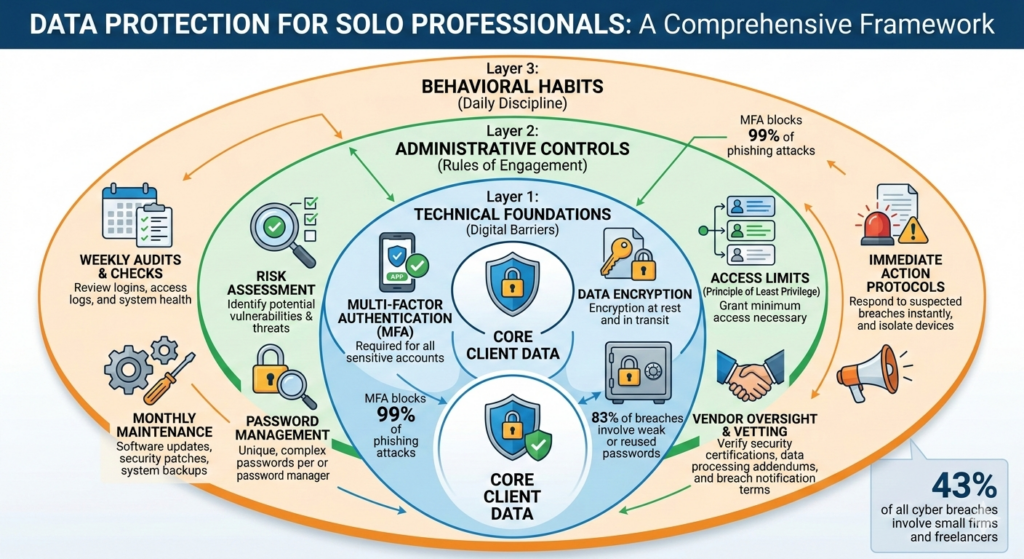
Effective Data Protection for Solo Professionals rests on three interconnected layers. Implement these systematically, and you’ll sleep better.
Layer One: Technical Foundations
Start with the basics that stop 99% of attacks:
- Multi-Factor Authentication (MFA) : Every single account handling client data requires two-step verification. Password plus text code, authenticator app, or security key. Microsoft reports this single habit blocks 99% of phishing attacks . The FTC now considers MFA mandatory for accessing nonpublic customer information .
- Encryption Everywhere: Data must be encrypted both “at rest” (on your hard drive) and “in transit” (over email or uploads). Enable FileVault (Mac) or BitLocker (Windows) immediately .
- Password Management: Stop reusing passwords. The Verizon Data Breach Report confirms 83% of breaches involve weak or reused credentials . Use a password manager—1Password, Bitwarden, or Dashlane—and generate unique complex passwords for every service.
Layer Two: Administrative Controls
Security isn’t just technology; it’s process:
- Designate Responsibility: Appoint someone—even if it’s you—as your security champion. This person oversees your information security program and ensures procedures are followed .
- Conduct a Risk Assessment: Inventory every location where client data lives. Physical files? Local computer? Cloud storage? Backup drives? Identify risks and document them . For firms with fewer than 5,000 consumers, requirements are reduced but core principles still apply .
- Limit Access: Not everyone needs everything. Use role-based permissions so employees, subcontractors, or even you access only what’s necessary for specific tasks .
Layer Three: Behavioral Habits
The human layer is where most failures occur:
- Weekly Audits: Every Friday, review shared folder permissions. Who has access? Should they still? Remove inactive users .
- Monthly Maintenance: Block one morning monthly as “Digital Maintenance Day.” Check all apps, passwords, and vendor settings .
- Immediate Action: When a project ends, delete or archive client data according to your disposal policy. The FTC requires disposal no more than two years after last access unless legally required otherwise .
The Vendor Trap: Their Risk Becomes Your Risk
Here’s what most solo professionals miss: every tool you use—email service, CRM, cloud storage, payment processor—creates potential vulnerabilities. According to NIST, 46% of U.S. breaches start with a third-party vendor that wasn’t properly verified .
Consequently, you must vet every vendor touching client data. Verify data center locations (U.S. or GDPR-compliant regions preferred), demand clear Data Processing Addendums with 48-hour breach notification clauses, and confirm annual SOC 2 or ISO 27001 certifications . Review these annually; vendor security postures change.
The Incident Response Plan: Hope Is Not a Strategy
Despite best efforts, things can still go wrong. If you maintain information for at least 5,000 consumers, the FTC requires a written incident response plan . However, even smaller operations should document one.
Your plan should address: goals for response, internal procedures when a security event occurs, clear roles and decision-making authority, external communication protocols, remediation processes for identified weaknesses, and documentation requirements . Practice it annually. The time to figure out who calls whom is not during a breach.
Building Trust Through Transparency
Here’s the paradox: clear security practices actually attract clients. When you present a detailed data protection clause in your contracts, serious clients don’t see “legalese”—they see professionalism . They see someone who’s been through the fire, learned the lesson, and values reputation enough to write it down.
A recent Salesforce Trust Report found 88% of small business owners rank “trust” higher than price when choosing partners . Confidentiality is part of that trust. When clients know their sensitive information won’t end up floating online, they exhale. They relax. They choose you.
The True Cost of Neglect
IBM’s 2024 Data Breach Report reveals that 74% of small business data incidents result from human error—not sophisticated hacking . We’re not talking about nation-state actors; we’re talking about wrong attachments, unprotected links, and conversations in coworking spaces.
The average cost for small businesses? Over $150,000 per incident when you factor in breach notification, credit monitoring, legal fees, and lost business . For a solo professional, that’s catastrophic.
However, those who implement written security plans and quarterly reviews reduce incident costs by an average of $148,000 . Prevention isn’t expensive; cleanup is.
If you’re over 50 years old and ready to leverage your experience into a thriving solo practice protected by professional-grade data practices, start with our free assessment at https://over50pros.com. The results will deliver your top three gig options matched to your skills. You’ll see fairly priced courses—including our comprehensive Data Protection for Solo Professionals workshop—designed to get you prepped for the premium end of the gig economy, where trust commands higher rates.
For more information, resources, and inspiration, subscribe to our weekly newsletter. We call it “The Front of the Check”.
We feel all people need to take control over their own futures. The newsletter will help you do it! Subscribe here! (Hotlink Subscribe here!) with https://frontofthecheck.com