By Sherman G. Mohr, Founder of Over50Pros
Empowering the Second Act Workforce
You’ve been treating your gig work seriously for months—perhaps years. You show up on time. You deliver quality. Clients refer their friends. Yet somehow, you’re still operating as a sole proprietor, mixing business income with personal accounts, and hoping nothing goes wrong. This is the gig economy’s most dangerous blind spot.
Here’s the truth that separates hobbyists from professionals: When to Form an LLC and Get an EIN isn’t a mystery—it’s a strategic decision with clear triggers. According to the Small Business Administration (SBA), nearly 75% of small businesses operate as sole proprietorships initially, but that structure offers zero protection for your personal assets [citation:0]. The IRS adds another layer: without an Employer Identification Number (EIN), you’re using your Social Security number for every transaction, exposing yourself to identity theft and complicating your tax situation .
The question isn’t whether you’ll eventually incorporate. It’s whether you’ll do it before or after something goes wrong.
The Galloway Framework: Structure Follows Scale
Professor Scott Galloway applies his signature clarity to this decision: “In business, structure should follow revenue, not precede it. Incorporating too early creates administrative drag without corresponding benefit. Incorporating too late exposes you to catastrophic personal liability. The sweet spot? When to Form an LLC and Get an EIN becomes obvious when you cross three thresholds: consistent monthly income above $3,000, any client requiring a W-9, or the acquisition of significant business assets. These aren’t arbitrary numbers—they’re the inflection points where the cost of informality exceeds the cost of structure.”
This framework eliminates guesswork. You’re not deciding based on fear; you’re deciding based on data.
The Liability Threshold: When Your Personal Assets Are at Risk
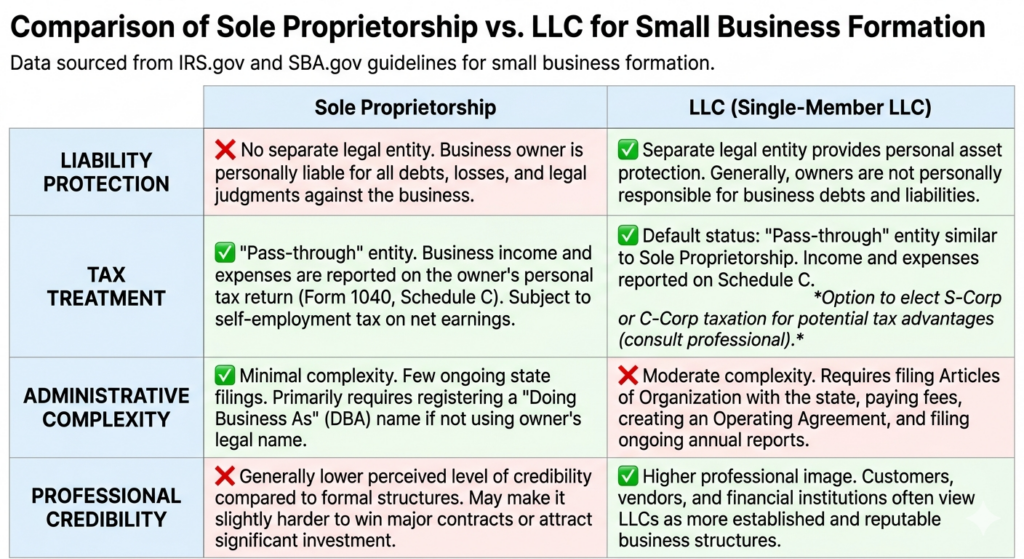
Let’s examine the most urgent trigger for forming an LLC: personal liability exposure. As a sole proprietor, your business and personal identity are legally inseparable. A client slips on your workspace floor? They can sue for your house. A project goes sideways and a contractor isn’t paid? They can garnish your personal bank account.
The LLC (Limited Liability Company) creates a legal firewall. According to SBA guidelines, this separation becomes essential once your business involves :
- Physical work on client property
- Handling client data or sensitive information
- Employees or subcontractors
- Significant equipment investments
- Contracts requiring indemnification clauses
For professionals over 50 protecting decades of accumulated assets, this protection isn’t optional—it’s foundational.
The Tax Efficiency Trigger: When Deductions Multiply
Beyond liability, the When to Form an LLC and Get an EIN calculation involves tax strategy. As a sole proprietor filing Schedule C, you can deduct legitimate business expenses. However, an LLC structured as an S-Corporation unlocks additional advantages once your net income exceeds approximately $40,000 annually.
IRS guidelines permit S-Corp owners to pay themselves a “reasonable salary” while taking remaining profits as distributions, which aren’t subject to self-employment tax [citation:0]. For a professional netting $60,000, this structure can save $4,000-$6,000 annually in taxes—far exceeding the administrative costs of maintaining the entity.
The calculation becomes: at what income level do tax savings justify the additional complexity? For most experienced gig workers, that threshold is $40,000-$50,000 in net profit.
The Professional Signal: When Clients Expect Formality
There’s a third trigger that operates beyond spreadsheets: professional credibility. Certain clients—particularly corporate clients, government agencies, and established small businesses—require vendors to have formal business structures.
An EIN (Employer Identification Number) signals that you’re a legitimate business, not a casual earner. According to IRS guidance, you need an EIN if you :
- Hire employees
- Operate as a partnership or corporation
- File certain tax returns
- Have a Keogh plan
- Handle payroll taxes
Moreover, many banks require an EIN to open business accounts, and some clients won’t issue 1099s without one. The moment a potential client asks for your W-9, the clock starts ticking on formalization.
The Step-by-Step Formation Guide
When you’ve crossed your thresholds, the process is straightforward. Here’s your roadmap:
Step One: Choose Your Structure
For most solo professionals, a single-member LLC provides ideal balance of protection and simplicity. Multi-owner operations should consider partnerships or multi-member LLCs. Higher earners should consult a tax professional about S-Corp election.
Step Two: File with Your State
LLCs are created at the state level, typically through the Secretary of State’s office. Filing fees range from $50-$500 depending on your state. You’ll file Articles of Organization and pay the required fee.
Step Three: Obtain Your EIN
Once your LLC is approved, visit IRS.gov to apply for your EIN. The online application takes minutes and is completely free. You’ll receive your number immediately upon completion.
Step Four: Open Business Accounts
Take your EIN and LLC formation documents to a bank and open dedicated business checking and savings accounts. This separation is essential for maintaining liability protection and simplifying tax preparation.
Step Five: Update Client Contracts
Notify existing clients of your new business structure. Provide updated W-9s and ensure future payments reference your LLC and EIN.
The Grandfather Clause Consideration
For existing clients who’ve worked with you as a sole proprietor, transitioning to an LLC requires communication but rarely creates friction. A simple script works:
*”Great news—my business has grown to the point where I’m formalizing operations. Effective [date], I’ll be operating as [Your Business Name], LLC. Your service and rates remain unchanged; you’ll just make future payments to the LLC. I’ve attached an updated W-9 for your records.”*
Most clients won’t blink. Those who ask questions will respect your professionalism.
The Annual Maintenance Reality
Forming an LLC isn’t a one-time event; it requires ongoing compliance. Most states require annual reports and franchise taxes, typically $50-$800 annually. Additionally, maintaining liability protection requires:
- Keeping business and personal finances completely separate
- Signing contracts in the business name
- Maintaining adequate business insurance
- Filing required state reports on time
These requirements aren’t burdensome, but they’re non-negotiable. Failure to maintain formalities can “pierce the corporate veil,” eliminating your liability protection.
From Informal Earner to Formal Business Owner
Ultimately, When to Form an LLC and Get an EIN marks the transition from gig worker to business owner. It’s the moment you declare—to yourself, to clients, and to the tax authorities—that this isn’t a hobby or a temporary arrangement. It’s a professional enterprise worthy of formal structure and protection.
For professionals over 50, this transition carries additional weight. You’ve spent decades building personal assets worth protecting. You’ve accumulated expertise worth packaging professionally. And you’ve earned the right to structure your work in ways that maximize both security and tax efficiency.
If you’re over 50 years old and ready to transform your gig income into a properly structured, asset-protected business, begin by understanding which opportunities match your experience. Take our free assessment at https://over50pros.com to discover your top three gig options. Then explore our fairly priced courses on business formation, tax strategy, and scaling your second-act enterprise.
For more information, resources, and inspiration, subscribe to our weekly newsletter. We call it “The Front of the Check”.
We feel all people need to take control over their own futures. The newsletter will help you do it! Subscribe here! (Hotlink Subscribe here!) with https://frontofthecheck.com