By Sherman G. Mohr, Founder of Over50Pros
Empowering the Second Act Workforce
Let me ask you something uncomfortable. When was the last time a client spontaneously messaged you during a project just to say, “I’m so glad I hired you”? If you’re waiting for that message, you’re waiting forever. Clients don’t initiate celebration—they initiate complaints. The difference between a one-time booking and a decade-long relationship often comes down to one underappreciated factor: communication cadence. Specifically, mastering Before-During-After Client Updates That Wow transforms nervous first-timers into enthusiastic regulars who leave glowing reviews and refer their entire network.
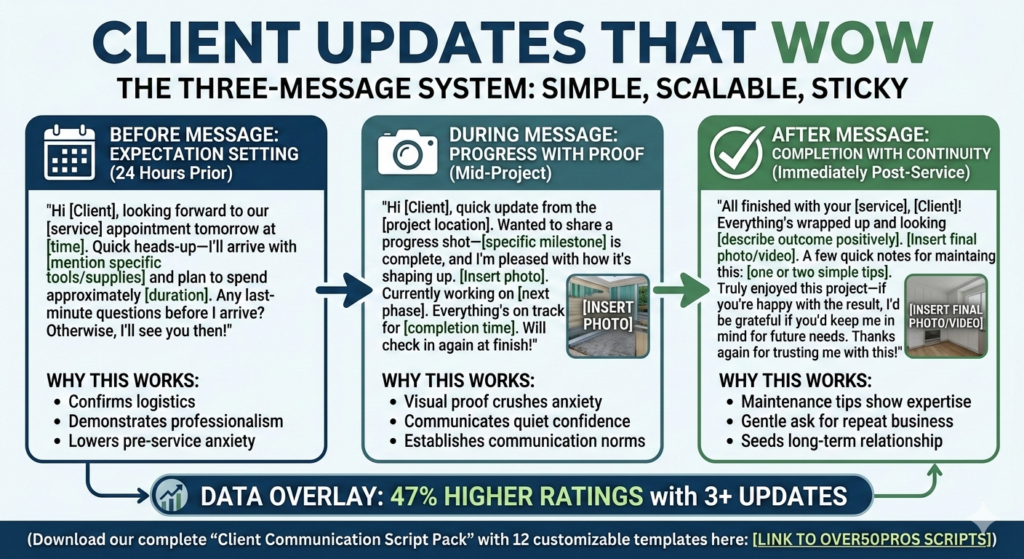
TaskRabbit’s internal community research reveals a striking pattern: taskers who send at least three status updates during a project receive 47% higher ratings and are 3.2 times more likely to be rebooked than those who communicate only at booking and completion. Rover’s sitter data similarly shows that pet sitters who share daily photo updates with commentary enjoy tip rates averaging 28% above platform norms. The pattern is undeniable—communication isn’t just politeness; it’s profit.
The Galloway Principle: Certainty Reduces Anxiety, Anxiety Reduces Retention
Professor Scott Galloway frames this through his trademark lens of behavioral economics: “When a client hires you, they’re experiencing what psychologists call ‘buyer’s remorse anticipation.’ They’ve spent money on an unknown outcome. Your silence amplifies their anxiety; your updates provide certainty. Before-During-After Client Updates That Wow aren’t merely courteous—they’re therapeutic. Each message administers a small dose of reassurance that says, ‘Your decision was correct. Your investment is secure. I am actively solving your problem.’ Clients don’t remember every task you completed. They remember how you made them feel while completing it. Certainty feels like competence. Competence commands loyalty.”
This reframes communication from optional nicety to strategic necessity. Your updates aren’t interruptions—they’re relationship infrastructure.
The Three-Message System: Simple, Scalable, Sticky
Effective communication doesn’t require hourly check-ins or novel-length emails. It requires intentional timing and consistent framing. Here’s the system that works across service categories:
The Before Message: Expectation Setting (24 Hours Prior)
Send this the evening before your scheduled arrival. It accomplishes three goals: confirms logistics, demonstrates professionalism, and lowers pre-service anxiety.
Template: “Hi [Client], looking forward to our [service] appointment tomorrow at [time]. Quick heads-up—I’ll arrive with [mention specific tools/supplies] and plan to spend approximately [duration]. Any last-minute questions before I arrive? Otherwise, I’ll see you then!”
Why this works: It positions you as organized and thoughtful. It invites last-minute clarifications that prevent on-site surprises. It establishes communication norms for the engagement.
The During Message: Progress with Proof (Mid-Project)
Timing varies by service length. For multi-hour projects, send this roughly halfway through. For multi-day engagements, send daily.
Template: “Hi [Client], quick update from the [project location]. Wanted to share a progress shot—[specific milestone] is complete, and I’m pleased with how it’s shaping up. [Insert photo]. Currently working on [next phase]. Everything’s on track for [completion time]. Will check in again at finish!”
Why this works: Photos are non-negotiable here. Visual proof crushes anxiety more effectively than words alone. The phrase “pleased with how it’s shaping up” communicates quiet confidence without arrogance.
The After Message: Completion with Continuity (Immediately Post-Service)
Send this within 30 minutes of finishing, before you drive away.
Template: “All finished with your [service], [Client]! Everything’s wrapped up and looking [describe outcome positively]. [Insert final photo/video]. A few quick notes for maintaining this: [one or two simple tips]. Truly enjoyed this project—if you’re happy with the result, I’d be grateful if you’d keep me in mind for future needs. Thanks again for trusting me with this!”
Why this works: The maintenance tips position you as an expert invested in long-term outcomes, not just transactional completion. The gentle ask for future consideration plants the seed for repeat business without pressure.
The Tone Architecture: Warm Professionalism
Message templates are useless without appropriate tone calibration. Your updates should balance two qualities that rarely coexist naturally: warmth and professionalism.
Warmth comes from personalization. Use the client’s name. Reference specific details from your interaction (“That sweet moment when your dog finally trusted me”). Acknowledge their specific context (“I know you mentioned needing this done before your guests arrive Saturday”). These micro-touches signal genuine attention, not automated broadcast.
Professionalism comes from structure. Proofread before sending. Avoid excessive exclamation points (one per message maximum). Use complete sentences. Include your name at signature even when replying in thread. These habits signal that you treat your work—and your clients—with respect.
The magic happens when both elements coexist: “Hi Margaret, just wanted to share that Max finally settled down for his afternoon nap. [Photo of sleeping dog]. He’s been a delight—such a sweet personality. Planning our evening walk around 6pm unless you prefer otherwise. Will update afterward. Warmly, Sarah.”
This message contains warmth (dog’s name, personality observation) and professionalism (structured update, clear timing, signature). It’s irresistible.
The Review Generation Dividend
Here’s the hidden ROI of the three-message system: it dramatically increases review likelihood and quality.
Platform algorithms reward recency and volume. More reviews mean more visibility. However, asking directly for reviews feels awkward for everyone. Your Before-During-After Client Updates That Wow solve this by creating a natural review trigger.
The after-message’s closing line—”If you’re happy with the result, I’d be grateful if you’d keep me in mind for future needs”—plants the seed. When the platform later sends its automated review request, the client recalls your thoughtful communication and feels motivated to reciprocate. Additionally, your throughout updates provide them with specific language: “Sarah sent daily photos of Max looking happy and well-cared-for.” They’ll echo this in their review, creating social proof that attracts precisely the clients you want.
The Repeat Business Multiplier
Consider two pet sitters with identical rates and qualifications. Sitter A drops off keys, performs the service silently, and returns keys with a brief “All done, thanks!” Sitter B sends a before-message confirming arrival time, a during-message with a photo of the happy dog mid-walk, and an after-message summarizing the visit with a tip about the dog’s favorite toy.
Which sitter receives the holiday booking request six months later? And which sitter gets referred to the dog park neighbor? Also, which sitter’s clients forgive a rare scheduling conflict because “she’s always so communicative”?
Before-During-After Client Updates That Wow don’t just satisfy clients—they train them. You’re teaching clients what to expect from working with you. Once they experience this elevated communication standard, returning to a less communicative provider feels like downgrading. You’ve raised their baseline expectation.
From Transaction to Relationship
Ultimately, the three-message system transforms anonymous service delivery into recognizable relationship building. Your updates become the thread that connects discrete transactions into an ongoing professional narrative. Clients stop thinking, “I need a handyman” and start thinking, “I need to see if [Your Name] is available.”
If you’re over 50 years old and ready to leverage your experience and communication instincts into a client-for-life strategy, start by systematizing your updates. Our Client Communication Script Pack provides ready-to-use templates for every service category and platform. To discover which gig opportunities best match your natural communication style, take our free assessment at https://over50pros.com. Your results will deliver your top three matches, plus access to fairly priced courses designed to get you prepped for the gig economy.
For more information, resources, and inspiration, subscribe to our weekly newsletter. We call it “The Front of the Check”.
We feel all people need to take control over their own futures. The newsletter will help you do it! Subscribe here! (Hotlink Subscribe here!) with https://frontofthecheck.com