By Sherman G. Mohr, Founder of Over50Pros
Empowering the Second Act Workforce
Here’s the wake-up call no one prepared you for when you left the corporate world. For decades, you enjoyed the quiet luxury of employer-sponsored health insurance. You picked a plan during open enrollment, maybe grumbled about the premium increase, and moved on. Now, as a solo professional building your Second Act, that safety net has vanished. Suddenly, Choosing Health Coverage as a Solo Pro feels less like a routine task and more like navigating a minefield blindfolded.
You’re not alone. According to recent data, a staggering number of self-employed individuals face a critical moment in 2026. The enhanced Affordable Care Act subsidies, which kept premiums manageable for millions, expired at the end of 2025 . Consequently, many freelancers and solo pros are confronting premium spikes that can reach thousands of dollars annually . Professor Scott Galloway frames it this way: “In the corporate world, health insurance is a hidden tax on your salary that you never see. As a solo operator, it becomes an exposed, jagged line item. You must treat it not as a personal expense, but as a strategic business cost—one that requires the same ruthless optimization you apply to your marketing budget or your software stack.”
This guide exists to demystify that optimization. Choosing Health Coverage as a Solo Pro in 2026 isn’t just about finding the cheapest monthly premium. It’s about understanding a transformed landscape where new rules—like the ability to use Health Savings Account funds for Direct Primary Care—create opportunities that didn’t exist last year . Your health is your business’s most valuable asset. Let’s protect it intelligently.
The New Landscape: What Changed in 2026
First, let’s understand the battlefield. For the past several years, pandemic-era enhancements to ACA subsidies made coverage surprisingly affordable, even for those with moderate incomes. Those enhancements are now history . The “subsidy cliff” has returned. This means that if your modified adjusted gross income exceeds 400% of the federal poverty level (approximately $63,000 for a single person in 2026), you may suddenly find yourself paying full, unsubsidized premiums .
Moreover, for those aged 50 and above, the math gets trickier. Insurance companies rate age heavily; a 64-year-old can easily pay three times more than a 21-year-old for the exact same plan . If your income places you just above that subsidy threshold, you’re responsible for the full, age-rated premium.
However, despair is not a strategy. Savvy solo pros know that 2026 also brought significant new tools to the table. The “One Big Beautiful Bill” introduced game-changing flexibility, particularly around Health Savings Accounts and Direct Primary Care .
Your 2026 Coverage Toolkit: Three Paths Forward
When Choosing Health Coverage as a Solo Pro, you now have three primary levers to pull. The smartest approach often involves combining them.
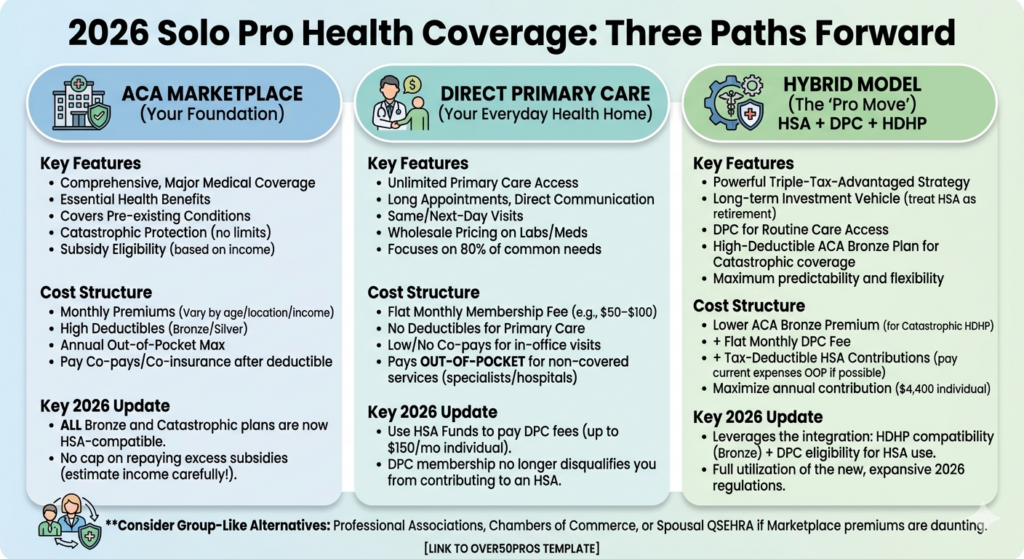
1. The ACA Marketplace (Your Foundation)
For most self-employed individuals, the ACA Marketplace remains the primary source for comprehensive, major medical coverage . It’s the only place where you can purchase plans that cover essential health benefits, pre-existing conditions, and catastrophic events without annual or lifetime limits.
- The Strategy: Estimate your annual income carefully. The Marketplace uses this to calculate premium tax credits. If your income varies, update your application throughout the year to avoid a nasty surprise at tax time—in 2026, there’s no longer a cap on repaying excess subsidies you received .
- Plan Levels: Match the metal level to your health pattern. Bronze plans feature lower premiums with higher cost-sharing (ideal if you’re generally healthy and have emergency savings). Gold plans have higher premiums but lower deductibles and copays (better if you manage chronic conditions or expect significant care) .
- Key 2026 Update: All Bronze and Catastrophic plans offered through ACA exchanges are now automatically considered HSA-compatible, even if they don’t meet traditional high-deductible requirements. This dramatically expands your options .
2. Direct Primary Care (Your Everyday Health Home)
Direct Primary Care (DPC) is a membership model. You pay a flat monthly fee (typically $50–$100) directly to a primary care practice. In return, you get unlimited access to your physician, longer appointments, same-or-next-day visits, and often wholesale pricing on labs and medications .
- The Strategy: Think of DPC as a “subscription” for 80% of your health needs. It covers the colds, the check-ups, the medication management, and the quick questions that would otherwise lead to expensive urgent care visits or ignored symptoms.
- Key 2026 Update: This is a massive game-changer. Starting January 1, 2026, you can now officially use HSA funds to pay for DPC membership fees (up to $150/month for individuals) . Furthermore, having a DPC membership no longer disqualifies you from contributing to an HSA, removing a major previous barrier .
3. Health Savings Account (Your Triple-Tax-Advantaged Engine)
If you pair a high-deductible health plan with an HSA, you unlock one of the most powerful tax tools available. Contributions are tax-deductible, growth is tax-deferred, and withdrawals for qualified medical expenses are tax-free .
- The Strategy: Max out your contributions. For 2026, individuals can contribute up to $4,400, families up to $8,750, with an additional $1,000 catch-up for those 55 and older . Treat your HSA not just as a checking account for co-pays, but as a long-term investment vehicle. Pay current small expenses out-of-pocket, let the HSA grow invested, and reimburse yourself decades later tax-free.
- The Hybrid Model: This is the “pro move.” Pair a high-deductible ACA Bronze plan (for catastrophic protection) with a DPC membership (for everyday care) and fund both with your HSA. You gain predictable primary care access, protection against major medical bills, and triple tax advantages .
Beyond the Individual: Group-Like Options
If you’re Choosing Health Coverage as a Solo Pro and find Marketplace premiums daunting, investigate whether you can access group pricing through other avenues.
- Professional Associations: Organizations like the National Association for the Self-Employed (NASE) or the Freelancers Union often provide access to health plans or resources for members .
- Chambers of Commerce: Some local chambers offer group health options to member businesses, even solo operations.
- Spousal Employment Strategy: If your spouse works in your business as a bona fide employee, you may be able to set up a Qualified Small Employer HRA (QSEHRA) to reimburse health expenses with pre-tax dollars, effectively turning your individual premiums into a business deduction that avoids payroll taxes .
Comparison Chart: Choosing Health Coverage as a Solo Pro
The Bottom Line: Structure Matters More Than Ever
In 2026, Choosing Health Coverage as a Solo Pro is not a passive, once-a-year chore. It is an active, strategic decision that intersects with your tax planning, your risk tolerance, and your cash flow. The expiration of enhanced subsidies means you cannot simply set and forget. You must engage.
Start by visiting Healthcare.gov to see your unsubsidized rates. Then, research DPC practices in your area—many offer free “meet and greet” consultations . Finally, run the numbers with a tax advisor. Can you contribute enough to an HSA to lower your modified adjusted gross income back below that subsidy cliff? Can you structure your business to deduct 100% of your premiums through the self-employed health insurance deduction? .
These questions have answers. Your job is to find them.
If you’re over 50 years old and navigating the complexities of health coverage while building your independent career, you don’t have to figure it out alone. Start by understanding which gig economy paths align best with your skills and lifestyle. Take our free assessment at https://over50pros.com to discover your top three opportunities. Then, explore our fairly priced courses—including our upcoming workshop on “Financial Wellness for Solo Pros”—designed to get you fully prepped for the freedom and responsibility of the gig economy.
For more information, resources, and inspiration, subscribe to our weekly newsletter. We call it “The Front of the Check”.
We feel all people need to take control over their own futures. The newsletter will help you do it! Subscribe here! (Hotlink Subscribe here!) with https://frontofthecheck.com