By Sherman G. Mohr, Founder of Over50Pros
Empowering the Second Act Workforce
You’ve reached that beautiful moment in life where “work” becomes optional. Perhaps you’re driving for a ride-share a few mornings a week, consulting part-time for your old industry, or walking dogs through Rover to stay active and social. It feels perfect—until tax season, or worse, until a letter arrives from the Social Security Administration explaining that your checks are smaller than expected. This is the reality of the Social Security Earnings Tests and Timing. Many retirees dive into the gig economy without understanding that if you’re below Full Retirement Age (FRA) and earning money, the government temporarily withholds a portion of your benefits. According to the Social Security Administration, for every $2 you earn above the annual limit, $1 is deducted from your benefits . This isn’t a penalty; it’s a test. And failing to plan for it can leave a significant gap in your monthly budget. Fortunately, with the right timing and knowledge of the 2026 thresholds, you can keep more of what you earn and what you’re owed.
The Galloway View: “The System Isn’t Punishing You; It’s Redistributing You”
Professor Scott Galloway has a way of cutting through bureaucratic fog. “Think of the Social Security Earnings Tests and Timing not as a tax on ambition, but as a timing mechanism,” he explains. “The government isn’t stealing your money; they’re holding it in a forced savings account that pays out when you hit Full Retirement Age. The math is simple: if you’re under FRA and you earn over $24,480 in 2026, you’re essentially lending your benefits back to the government at a 50% clip until you stop working or cross the threshold.” .
He continues, “However, the nuance is critical. Once you hit FRA, the leash comes off. You can earn Bezos-level income, and your Social Security check remains untouched. Furthermore, because you kept working and paying taxes, the SSA recalculates your benefit upward to account for those withheld months. This means the earnings test is actually a forced deferral strategy. The question isn’t whether you should work—it’s whether you understand the timing of your cash flows.” .
The 2026 Numbers: Know Your Thresholds
To navigate this successfully, you need the hard data. The limits adjust annually for inflation, and for 2026, they offer a slightly wider berth for workers.
The Two Tiers of the Earnings Test
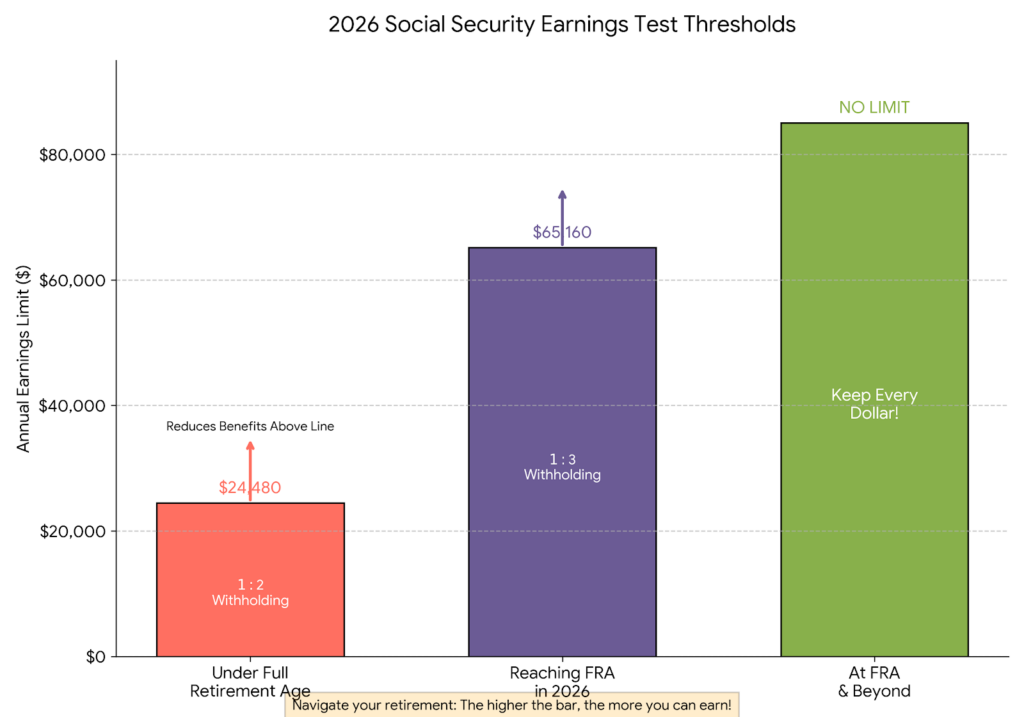
- If you are under Full Retirement Age for the entire year: You can earn up to $24,480 in 2026 without any benefit reduction . Once you cross that line, the SSA deducts $1 for every $2 you earn above the limit.
- If you will reach Full Retirement Age in 2026: The rules loosen significantly for the months before your birthday. The earnings limit jumps to $65,160 . Above that line, the withholding rate is more forgiving: $1 for every $3 earned.
- The Month You Reach FRA and Beyond: Starting in the month you attain Full Retirement Age, the earnings test vanishes. You can earn unlimited income, and your full benefit arrives every month .
Visualizing the Impact
To make this crystal clear, we’ve mapped out the “Cliff Effects” based on SSA data.
Strategic Timing: How to Maximize Your Gig Income
Understanding the Social Security Earnings Tests and Timing allows you to plan your gig work strategically rather than reactively.
- The “Bridge Job” Strategy: If you retire at 62 but aren’t ready to stop entirely, consider keeping your gig income strictly under the $24,480 limit. This allows you to collect a reduced (but present) Social Security check while enjoying the benefits of light work . This is ideal for those who want to “dabble” in the gig economy without administrative headaches.
- The “Delay and Conquer” Approach: If you enjoy working and can afford to wait, consider delaying your Social Security claim until FRA or even age 70. By waiting, you avoid the earnings test entirely because you aren’t collecting benefits yet. Meanwhile, your future benefit grows by roughly 8% per year you delay . Once you finally claim, you get the maximum check and you can work unlimited hours.
- The “Over-Earn and Reclaim” Mindset: Don’t be afraid of exceeding the limit. As Professor Galloway noted, the money isn’t lost. If you earn $30,000 above the limit, you’ll have $15,000 withheld. However, upon reaching FRA, the SSA recalculates your benefit to give you credit for those months of withheld payments, essentially increasing your monthly check for the rest of your life .
The Ramsey Reality Check
Personal finance expert Dave Ramsey often simplifies this dilemma: “You’re eligible at 62, but you won’t get your full check until 67. If you take it early because you need the money, fine. But if you take it early and keep working a high-paying job, you’re just asking the government to hold your allowance for a while” . This underscores the importance of aligning your work intensity with your income needs. If your gig is purely for “fun money” or social engagement, staying under the limit is easy. If your gig is replacing a salary, you need to view the temporary withholding as a deferred bonus.
Actionable Advice for the Over-50 Gig Worker
- Check Your Birth Year: Your Full Retirement Age depends on your birth year. For those born in 1960 or later, FRA is 67 .
- Monitor Your Earnings: Keep a running tally of your net self-employment income. If you’re approaching the limit and don’t want to deal with withholding, you might reduce your hours in December.
- Report Changes Immediately: If your estimated earnings change during the year, contact the SSA. Adjusting your estimate can prevent an unexpected large withholding later .
Ultimately, the Social Security Earnings Tests and Timing are navigable waters. They don’t have to sink your retirement dreams. By treating the rules as a roadmap rather than a roadblock, you can enjoy the flexibility of the gig economy while ensuring your long-term benefits remain robust.
If you’re over 50 years old and interested in leveraging your experience and desires into a Second Act Advantage, take our free assessment at https://over50pros.com. The results will deliver your top three gig options that fit your lifestyle and income goals. You’ll see fairly priced courses designed to get you prepped for the gig economy, including our detailed module on retirement planning for gig workers!
For more information, resources, and inspiration, subscribe to our weekly newsletter. We call it “The Front of the Check”.
We feel all people need to take control over their own futures. The newsletter will help you do it! Subscribe here! (Hotlink Subscribe here!) with https://frontofthecheck.com