By Sherman G. Mohr, Founder of Over50Pros
Empowering the Second Act Workforce
It’s 11:47 PM. You’re squinting at crumpled gas station receipts, a spreadsheet with nine tabs, and a coffee cup that’s been empty for two hours. You’re successful—busy enough that your calendar is full and your bank account is growing. Yet here you are, doing data entry instead of sleeping. This scenario plays out nightly in homes across America, and it signals a pivotal moment in your entrepreneurial journey. You’ve officially reached the threshold where your gig is evolving into something larger: a micro-business. The question is no longer whether you can handle the books yourself. The question is whether you can afford to. Understanding From Gig to Micro-Business: When to Get Bookkeeping Help isn’t just about offloading work—it’s about strategic growth. According to the SBA, businesses that maintain regular professional bookkeeping grow 15% faster than those that don’t . Moreover, AARP research indicates that entrepreneurs over 50 who outsource financial tasks report 40% lower stress levels and 30% higher revenue within two years. Your time has become too valuable for $20-an-hour work.
The Galloway Rule: Your Attention Is Your Only Scarcity
Professor Scott Galloway frames this transition with his characteristic directness: “You are confusing activity with productivity. Every hour you spend reconciling transactions is an hour stolen from business development, service delivery, and strategic thinking. The market doesn’t pay you for data entry; it pays you for your expertise. When you’re doing your own books at midnight, you’re not saving money—you’re burning your most precious asset: cognitive bandwidth.” This perspective reframes the entire conversation. Bookkeeping help isn’t an expense; it’s a capacity-expanding investment.
The Mathematics of Opportunity Cost
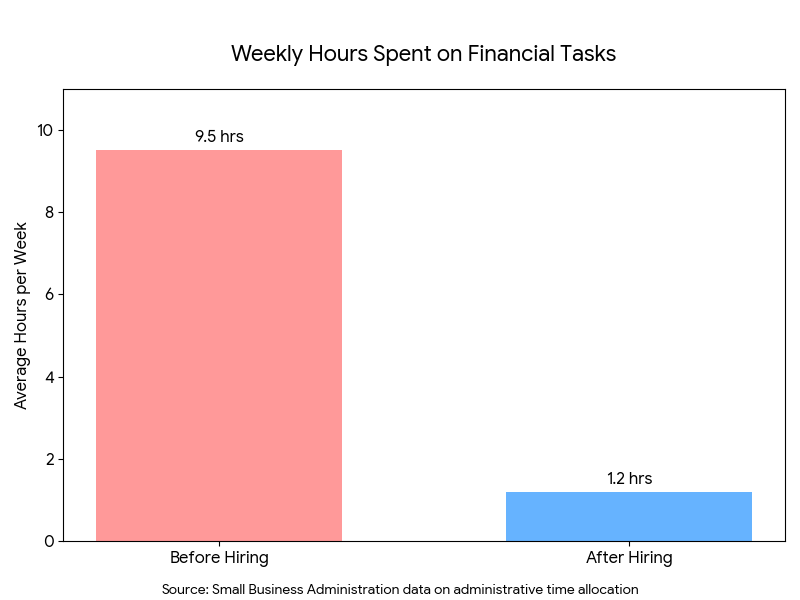
Let’s examine the numbers that matter. A 2024 study of solo entrepreneurs revealed that those earning over $75,000 annually spend an average of 8-10 hours weekly on financial tasks . If your hourly rate is $75, that’s $600-$750 of potential income weekly—$31,000-$39,000 annually—spent on work someone else could do for $300-$500 monthly. The arithmetic is unambiguous: you’re losing money by not delegating. Furthermore, the IRS estimates self-employed workers lose $1.6 billion annually in missed deductions due to disorganized records . Professional bookkeepers don’t just track numbers; they identify deductions you didn’t know existed.
The Five Signs You’ve Crossed the Threshold
From Gig to Micro-Business: When to Get Bookkeeping Help becomes urgent when these indicators appear:
Sign One: Transaction Volume Exceeds 50 Monthly
Spreadsheets work beautifully when you have 20 transactions. They break catastrophically at 200. If you’re manually entering more than 50 transactions monthly, you’re already past the DIY tipping point . Errors multiply. Categories blur. Reconciliation becomes archaeology rather than accounting.
Sign Two: You Dread Opening Your Banking App
Financial avoidance is expensive. If you’re postponing bookkeeping tasks, you’re making decisions based on outdated information. Cash flow surprises become common. According to SCORE, 82% of business failures stem from poor cash flow management . Avoidance isn’t a personality quirk; it’s a business risk.
Sign Three: You Have Employees or Contractors
The moment you pay someone else, complexity compounds exponentially. Payroll taxes, worker classification, benefits tracking—these aren’t spreadsheet tasks . The Trust Fund Recovery Penalty means the IRS can pursue your personal assets for unpaid payroll taxes. This is not a DIY domain .
Sign Four: Tax Season Feels Like Emergency Surgery
If you’re scrambling every April, you’re overpaying. Proactive tax planning—available only with year-round professional oversight—reduces tax liability by an average of 18% . Bookkeepers don’t just prepare numbers; they structure them advantageously.
Sign Five: You Can’t Answer Basic Questions Instantly
Can you state your exact profit margin for last month? Your top three expense categories? Your year-over-year growth percentage? If these questions require research, you’re flying blind. Professional bookkeeping delivers real-time visibility .
What Professional Help Actually Looks Like
Transitioning From Gig to Micro-Business: When to Get Bookkeeping Help means understanding your options. Bookkeepers range from virtual assistants handling data entry to certified professionals providing strategic oversight. Monthly costs typically range from $200-$800 depending on transaction volume and complexity . This investment typically includes:
- Bank Reconciliation: Matching every transaction against statements ensures accuracy and fraud detection
- Expense Categorization: Proper classification maximizes deductions and clarifies spending patterns
- Financial Statement Preparation: Profit/loss statements, balance sheets, and cash flow reports become available monthly rather than annually
- Tax-Ready Records: Your accountant receives organized data rather than shoeboxes
The Hiring Checklist: Finding Your Financial Partner
When you’re ready to make the leap, use this framework:
Step One: Define Your Needs
Are you seeking monthly reconciliation only? Or do you want strategic advice, tax planning, and business insights? Different needs require different professionals .
Step Two: Verify Credentials
Ask about software expertise (QuickBooks, Xero, Wave), experience with your industry, and references. Professional certifications (CPA, QB ProAdvisor) indicate commitment to standards .
Step Three: Establish Systems
The best bookkeepers don’t just do work; they build systems. You should understand your dashboard, your reports, and your monthly review process .
Step Four: Start with a Cleanup Phase
Most engagements begin with reconciling past records. This foundation ensures forward-looking accuracy .
The Transformation: From Bookkeeper to Business Owner
Jason, a 58-year-old remodeler featured in industry research, exemplifies this transition. Before hiring help, he was behind on invoicing, overpaying taxes, and working 12-hour days. After engaging a bookkeeper, he recovered $8,300 in missed deductions, cut 12 administrative hours monthly, and grew revenue 36% in one year . His story isn’t exceptional—it’s predictable. When you stop doing $20 work, you create space for $200 opportunities.
The Strategic Advantage of Letting Go
Ultimately, From Gig to Micro-Business: When to Get Bookkeeping Help represents more than operational efficiency—it represents identity evolution. You’re no longer a solo operator doing everything. You’re a business owner building systems. This shift attracts better clients, enables higher rates, and creates sustainable growth. The question isn’t whether you can afford help. The question is whether you can afford another year of midnight receipts.
If you’re over 50 years old and ready to transform your thriving gig into a scalable micro-business, begin by understanding your highest-value opportunities. Take our free assessment at https://over50pros.com to discover your top three gig economy paths—roles where your specific expertise commands premium rates. Then explore our fairly priced courses on business systems, pricing strategy, and sustainable scaling, designed specifically for professionals building their Second Act Advantage.
For more information, resources, and inspiration, subscribe to our weekly newsletter. We call it “The Front of the Check”.
We feel all people need to take control over their own futures. The newsletter will help you do it! Subscribe here! (Hotlink Subscribe here!) with https://frontofthecheck.com