By Sherman G. Mohr, Founder of Over50Pros
Empowering the Second Act Workforce
Let’s name the anxiety that keeps too many gig workers awake on the 28th of each month. You’ve had a stellar January—projects lined up, invoices paid, momentum building. February arrives, and suddenly? Crickets. The inquiries slow. The bookings pause. The bank account dwindles. This isn’t a failure of skill or effort. It’s the fundamental architecture of gig life: lumpy income. Consequently, even successful freelancers find themselves ricocheting between abundance and scarcity, never quite secure. The solution isn’t hustling harder during the slow months. The solution is Building a Three-Month Cushion for Lumpy Income. According to the AARP Financial Resilience Toolkit, gig workers with three months of essential expenses saved report 63% lower financial stress levels and make better long-term decisions because fear isn’t driving their choices. Your income may fluctuate. Your peace of mind shouldn’t.
The Galloway Diagnosis: Volatility Is the Price of Autonomy
Professor Scott Galloway frames this challenge with his characteristic clarity: “The trade-off for freedom is uncertainty. Employees trade control for predictability. Gig workers trade predictability for control. Consequently, you must build systems that absorb the volatility inherent in your choice. Building a Three-Month Cushion for Lumpy Income isn’t optional discipline—it’s structural necessity. Think of it as your personal liquidity buffer against the market’s whims. Without it, you’re always negotiating from weakness, always accepting the client who pays late or the project that underpays. With it, you operate from strength, choosing work that aligns with your value.”
This reframes the cushion entirely. It’s not hoarded cash; it’s purchased freedom. Every dollar in your cushion buys you another day of choosing clients rather than begging for them.
Why Three Months? The Data Behind the Number
You’ve likely heard “three to six months of expenses” as generic advice designed for traditional employees. For gig workers, the calculus differs.
Analysis of Rover community threads reveals that pet sitters and dog walkers experience income fluctuations averaging 40% between peak seasons (summer, holidays) and slower periods (late winter, early fall). TaskRabbit taskers report similar patterns, with home repair and organizing work peaking during spring and fall, then contracting during holiday months.
Three months represents the average duration of these cyclical slow periods across multiple gig categories. It’s enough time to ride out a typical drought without touching retirement accounts or accumulating high-interest debt. It’s also achievable—most gig workers can build this within 12-18 months through systematic saving, whereas six months can feel so daunting that they never start.
Calculating Your Number: The Honest Math
Generic advice tells you to save “three months of expenses.” That’s dangerously vague. Here’s the precise formula for gig workers:
Step One: Calculate Your Essential Monthly Floor
List every expense that must be paid regardless of income:
- Housing (rent/mortgage)
- Utilities (minimum required, not average)
- Food (groceries, not restaurants)
- Transportation (loan payment, fuel minimum)
- Insurance (health, auto, liability)
- Debt minimums
- Essential medications
This is your survival number. Not your lifestyle number. Your floor.
Step Two: Add the Gig Worker Premium
Traditional employees receive unemployment insurance when work disappears. You don’t. Consequently, add 15% to your essential floor for “self-insurance”—the reality that you must cover gaps entirely on your own.
Step Three: Multiply by Three
Essential Floor × 1.15 (Gig Premium) × 3 Months = Your Three-Month Cushion Target
Example: Essential expenses of $3,000 monthly × 1.15 = $3,450 monthly need × 3 = $10,350 target.
This number is specific, achievable, and mathematically honest about your situation.
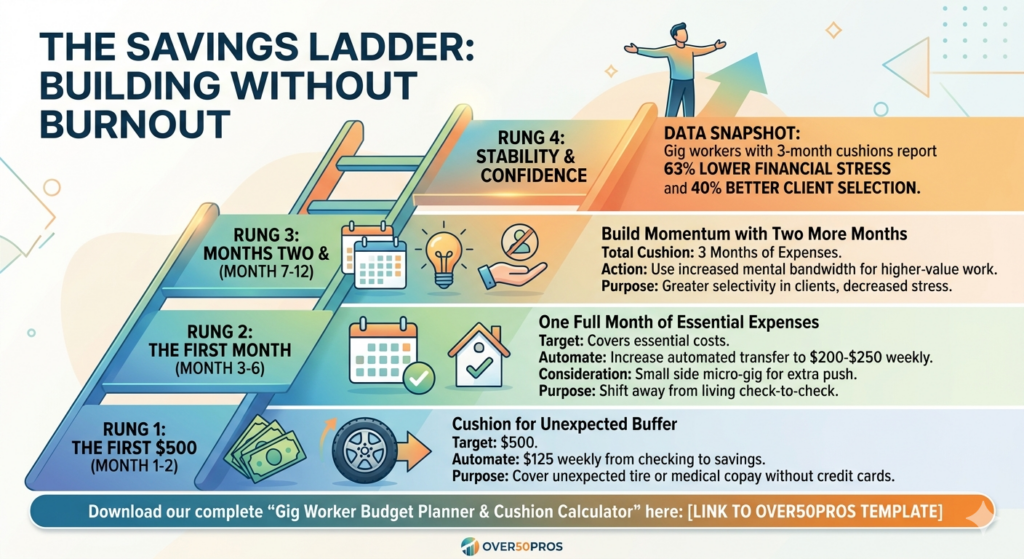
The Savings Ladder: Building Without Burnout
Staring at a five-figure target induces paralysis. Consequently, successful builders use the ladder approach—small, sequenced wins that compound.
Rung One: The First $500 (Month 1-2)
This isn’t a cushion yet; it’s a buffer. It covers the unexpected tire replacement or medical copay that would otherwise hit a credit card. Automate $125 weekly from checking to savings. Don’t think about the full target. Just build the buffer.
Rung Two: The First Month (Month 3-6)
Once the buffer exists, shift focus to one full month of essential expenses. Increase your automated transfer to $200-250 weekly. Consider a temporary side micro-gig—one weekend monthly of additional work—dedicated entirely to this goal. The psychological shift when you hit one month is profound. You’re no longer living check-to-check.
Rung Three: Months Two and Three (Month 7-12)
With momentum established, the final two months accumulate faster. Your stress has decreased, freeing mental bandwidth for higher-value work. You may find yourself turning down marginal clients because you no longer fear next week. This selectivity often increases income, accelerating the final push.
Where to Park Your Cushion: Accessibility Matters
Your cushion isn’t an investment. It’s insurance. Consequently, it requires different rules than retirement accounts.
Accessibility Over Returns: A high-yield savings account (currently 4-5% APY) outperforms checking while maintaining instant liquidity. Money market accounts offer similar benefits. Avoid CDs with withdrawal penalties or market investments that could be down precisely when you need funds most.
Separation Psychology: Open a dedicated account labeled “Income Cushion” or “Freedom Fund.” Research consistently shows that named, separate accounts reduce the temptation to raid savings for non-emergencies. Out of sight remains out of mind, but accessible when required.
The Refill Protocol: When you must draw from your cushion during a slow period, rebuilding becomes the immediate priority once income resumes. Treat it like repaying yourself—because that’s exactly what you’re doing.
The Rover Wisdom: Community Strategies That Work
Rover’s community forums reveal creative approaches from seasoned pet sitters who’ve mastered income smoothing. One top-rated sitter describes her “seasonal staircase”: during summer peak, she saves 30% of every booking specifically for January-February, her market’s slowest period. Another uses “cushion milestones” as booking incentives—once she hits a savings target, she allows herself one professional development purchase (new photography equipment, updated marketing materials) that actually increases future income.
These aren’t deprivation strategies. They’re systematic approaches to treating your business like the professional enterprise it is.
From Scarcity Mindset to Strategic Patience
Here’s what happens when you achieve your three-month cushion. You stop accepting clients who feel wrong, stop discounting for urgency, and start saying, “Let me check my availability” rather than “When can you meet?” The power dynamic shifts from begging to choosing.
Building a Three-Month Cushion for Lumpy Income isn’t hoarding. It’s the difference between reacting to the market and responding to it. Reacting is desperate. Responding is strategic. Your cushion purchases the time required for strategy.
If you’re over 50 years old and ready to transform feast-or-famine cycles into sustainable, confident income, start with the numbers that matter. Download our Budget Planner Template to calculate your precise cushion target, then take our free assessment at https://over50pros.com to discover your top three gig economy opportunities—roles where your specific expertise commands consistent, premium rates. Our fairly priced courses on financial resilience and business systems are designed specifically for professionals building their Second Act Advantage.
For more information, resources, and inspiration, subscribe to our weekly newsletter. We call it “The Front of the Check”.
We feel all people need to take control over their own futures. The newsletter will help you do it! Subscribe here! (Hotlink Subscribe here!) with https://frontofthecheck.com