By Sherman G. Mohr, Founder of Over50Pros
Empowering the Second Act Workforce
Let’s challenge a destructive assumption. Somewhere along the way, we absorbed the belief that productivity equals hours logged. The person who works longest wins. For those of us over 50 juggling family obligations, health priorities, and a growing gig practice, this belief isn’t just wrong—it’s actively harmful. It leads to burnout, resentment, and ironically, declining output. There’s a better way. It’s called Managing Energy, Not Hours. This approach, grounded in research from Daniel Pink’s When and validated by AARP work-life studies, flips the traditional productivity script. Instead of asking “How many hours can I grind?” you ask “When am I naturally at my best?” The results speak for themselves: professionals who align challenging work with their peak energy periods report 30% higher satisfaction and 25% greater output than those who simply power through . Your experience deserves smarter strategy, not longer hours.
The Galloway Principle: Work With Your Biology, Not Against It
Professor Scott Galloway frames this shift with his characteristic directness: “Capitalism rewards output, not attendance. Yet most of us organize our days like factory workers from 1920—arrive early, push through, leave late. This is biological illiteracy. Human energy ebbs and flows on predictable circadian rhythms. Managing Energy, Not Hours means recognizing that a focused ninety minutes during your peak window generates more value than four hours of distracted, low-energy effort. For professionals over 50, this isn’t optional—it’s essential. You’re not competing on stamina anymore. You’re competing on wisdom, judgment, and execution speed. Schedule accordingly.”
He’s correct. The era of proving ourselves through exhaustion is over. The era of strategic energy deployment has begun.
The Science of Your Day: Understanding Your Energy Architecture
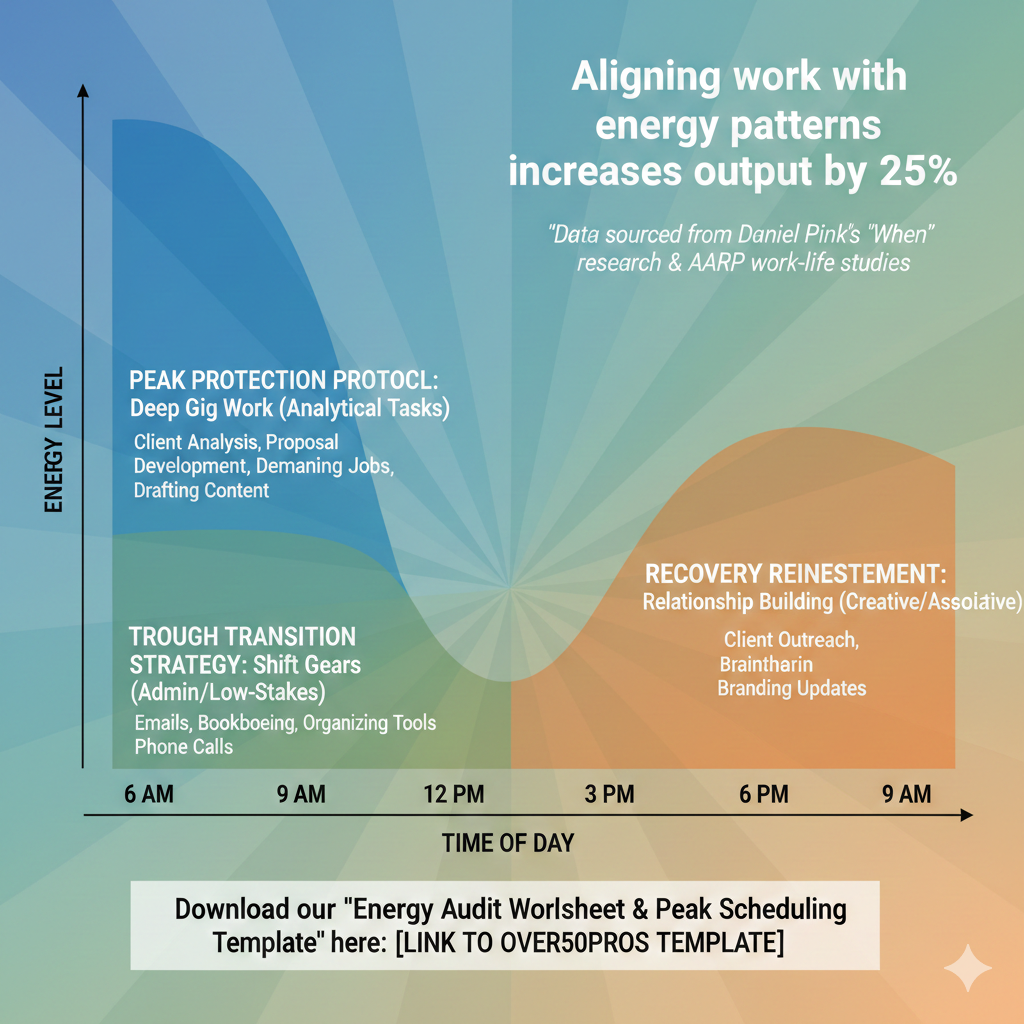
Daniel Pink’s extensive research reveals a consistent pattern: most humans experience three distinct phases daily—peak, trough, and recovery . The timing varies by chronotype, but the structure remains.
The Peak (Analytical Excellence)
For approximately 75% of people, mornings deliver sharpest analytical thinking . This is when complex problem-solving, strategic planning, and high-concentration tasks thrive. Your peak window typically lasts three to four hours.
The Trough (Recovery Required)
Mid-afternoon brings an energy dip. Your brain craves rest. Pushing through with caffeine and willpower yields diminishing returns. This is administrative time, walking meetings, or genuine breaks.
The Recovery (Creative Renewal)
Late afternoon and evening often spark creative insight. Your guarded analytical brain relaxes, allowing novel connections. This suits brainstorming, relationship building, and big-picture thinking.
The key insight? Different work demands different energy states. Matching them deliberately transforms productivity.
The Over50Pros Energy Audit: Identify Your Peak Windows
Before restructuring your gig schedule, diagnose your patterns. Track your energy and focus for one week using these questions:
- What time do you naturally wake without an alarm?
- When during the day do you feel most mentally sharp?
- When do you experience the afternoon slump?
- What time do you feel a second wind?
Most over-50 professionals discover their peak window occurs earlier than they realized—and they’ve been wasting it on email. Consequently, they tackle their most demanding client work during trough hours, producing mediocre results and requiring extensive revision.
Managing Energy, Not Hours demands the opposite: protect your peak like a VIP lounge. No email. No administrative noise. Just high-value client work.
Structuring Your Gig Schedule Around Energy, Not Clocks
Here’s how this translates into practical weekly planning for gig workers balancing multiple responsibilities.
The Peak Protection Protocol
Block your peak window daily for “deep gig work”—the tasks requiring your fullest cognitive engagement. For a consultant, this means complex client analysis or proposal development. While for a handyman, this means the most technically demanding jobs. Also, a writer, this means drafting new content. Guard this time ruthlessly. No exceptions.
The Trough Transition Strategy
When energy dips, shift gears. Respond to client emails. Update your bookkeeping. Organize your tools. Schedule low-stakes phone calls. Outsource nothing that matches your current energy state. Consequently, you maintain momentum without fighting your biology.
The Recovery Reinvestment
During creative windows, engage in relationship-building activities. Reach out to former clients. Brainstorm new service offerings. Update your professional branding 50+ materials. These tasks benefit from relaxed, associative thinking—exactly what your recovery phase provides.
The Family and Health Integration
For midlife gig workers, Managing Energy, Not Hours isn’t just about productivity—it’s about sustainability. You’re likely sandwiching client work between aging parent appointments, grandchild pickups, and your own health priorities.
The Strategic Boundary
Communicate your energy architecture to family. “I’m unavailable for non-emergencies between 8 and 11 AM—that’s when I serve clients. After 2 PM, I’m flexible.” Most families respect clear boundaries more than vague exhaustion.
The Health Investment
Paradoxically, taking breaks during your trough increases total output. A twenty-minute walk, a proper lunch away from screens, or a brief nap restores cognitive capacity. The AARP work-life studies confirm that professionals who prioritize midday recovery report lower stress and higher evening energy for both family and creative work .
The Guilt Release
Release the guilt of not working constantly. Your value isn’t measured in hours; it’s measured in outcomes. A client cares that you solved their problem brilliantly, not that you suffered to do so.
From Grinding to Thriving
Consider two virtual assistants with identical skills. Assistant A works sporadically throughout the day, responding to emails immediately, fitting client work into stolen moments, and feeling perpetually behind. Assistant B protects her 9 AM to 12 PM peak window for deep client work, batches emails at 2 PM, and handles creative marketing during evening recovery hours. Who delivers higher quality? Who feels more sustainable? Assistant B, every time. Managing Energy, Not Hours isn’t laziness—it’s strategic intelligence.
The Cumulative Advantage
Here’s what experienced pros discover: energy management compounds. Each day you work with your biology, you build momentum. Your quality improves, clients notice, and referrals increase. Consequently, you can raise rates while working fewer hours. This is the virtuous cycle that Managing Energy, Not Hours enables.
Your decades of experience have taught you what matters. Now apply that wisdom to how you work.
The Freedom to Work Smarter
Ultimately, Managing Energy, Not Hours liberates you from the tyranny of the clock. It acknowledges that you’re not twenty-five anymore—and thank goodness. You’re wiser, more efficient, and more selective. Your work deserves a container that honors your biology, your family, and your health simultaneously.
If you’re over 50 years old and ready to transform how you structure your gig practice, start by understanding your unique energy patterns. Our Time Mastery Course at Over50Pros walks you through advanced scheduling strategies, client communication around availability, and sustainable growth frameworks. To discover which gig opportunities align best with your natural rhythms, take our free assessment at https://over50pros.com.
For more information, resources, and inspiration, subscribe to our weekly newsletter. We call it “The Front of the Check”.
We feel all people need to take control over their own futures. The newsletter will help you do it! Subscribe here! (Hotlink Subscribe here!) with https://frontofthecheck.com