By Sherman G. Mohr, Founder of Over50Pros
Empowering the Second Act Workforce
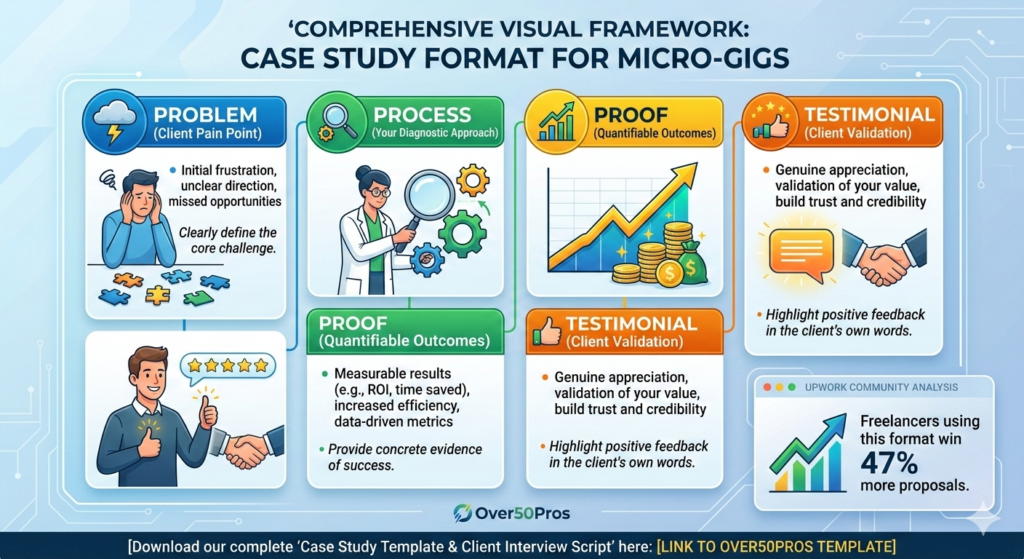
Let’s challenge a common misconception. You believe you need a massive, six-month engagement or a Fortune 500 client to create a compelling case study. Consequently, you publish nothing. Your portfolio remains a list of duties rather than a collection of victories. This is a costly error. The truth is that your smallest, most focused micro-gig often provides the clearest window into your value. A well-constructed Case Study Format for Micro-Gigs transforms a two-hour task into undeniable proof of capability. According to Upwork’s seller community data, freelancers who publish at least three detailed case studies in their portfolios win 47% more proposals than those listing only general experience . Your experience isn’t measured by project size; it’s measured by impact delivered. It’s time to document accordingly.
The Galloway Lens: Specificity Beats Scale
Professor Scott Galloway dissects marketing effectiveness with surgical clarity: “Generalists starve. Specialists feast. Yet even specialists make the mistake of describing what they do rather than proving what they’ve done. A Case Study Format for Micro-Gigs solves this by forcing specificity. You’re not saying ‘I help with bookkeeping.’ You’re showing ‘I helped a solo consultant reduce monthly reconciliation time from eight hours to ninety minutes.’ Which statement closes business? The second, every time. Specificity triggers belief. Belief triggers booking. The scale of the project is irrelevant. The clarity of the outcome is everything.”
This reframes your portfolio entirely. You’re not seeking permission to showcase large projects; you’re recognizing that small, well-documented wins are often more persuasive than vague descriptions of impressive-sounding engagements.
The Four-Part Case Study Architecture
Effective Case Study Format for Micro-Gigs follows a narrative arc that mirrors how clients actually decide. Each section serves a distinct psychological purpose.
Section One: The Problem (Establish the Pain)
Begin with the client’s situation before you arrived. What was broken, frustrating, time-consuming, or expensive? Be specific without betraying confidentiality. “A local pet sitter was manually tracking client payments across three different apps, spending four hours weekly reconciling spreadsheets.” This specificity allows readers to recognize their own situation in your description. Consequently, emotional engagement begins immediately.
Section Two: The Process (Establish Your Competence)
Describe your approach without becoming a technical manual. What did you assess? What solution did you design? Why that particular approach? This section demonstrates that you don’t just execute tasks—you diagnose problems and prescribe solutions. “I audited her current workflow, identified redundant data entry points, and implemented a consolidated payment tracking system within QuickBooks, including automated receipt generation.”
Section Three: The Proof (Establish the Outcome)
Quantify whenever possible. Numbers penetrate consciousness more effectively than adjectives. Hours saved. Revenue increased. Stress eliminated. Errors reduced. “The sitter now completes all weekly financial reconciliation in forty-five minutes—saving 3.5 hours weekly, or 182 hours annually. She reports zero payment disputes since implementation and has added two new clients without increasing administrative burden.”
Section Four: The Testimonial (Establish Social Validation)
A direct quote from the client authenticates everything preceding it. “Sarah, the pet sitter, shared: ‘I was drowning in spreadsheets. Now I actually understand my profitability. I’ve recommended him to three other sitters already.'”
This four-part structure transforms a simple bookkeeping task into a compelling narrative of transformation. Notice what’s absent? Buzzwords. Generic claims. Vague promises. Only specific, verifiable outcomes remain.
Why Micro-Gigs Create Superior Case Studies
Here’s an insight that surprises many experienced freelancers: smaller projects often produce cleaner, more persuasive case studies than larger engagements.
Large corporate projects involve multiple stakeholders, competing priorities, and diluted credit. Attributing outcomes cleanly becomes nearly impossible. Micro-gigs, conversely, feature clear before-and-after states. The problem is contained. Your solution is direct. The outcome is measurable. Consequently, your Case Study Format for Micro-Gigs achieves narrative clarity that complex engagements cannot match.
Consider Fiverr’s top-rated sellers. Analysis of their profiles reveals that successful freelancers don’t just list services—they publish “success stories” documenting specific client challenges and resolutions . These micro-case studies function as trust accelerators, reducing the perceived risk of hiring someone new.
Building Your Case Study Library: A Practical System
Creating a single case study requires intentionality. Building a library requires a system.
Step One: Identify Candidate Projects
Review your last fifteen completed gigs. Which had the clearest before-and-after contrast? And which client expressed genuine gratitude? Also, which outcome can you quantify? Flag three to five candidates.
Step Two: Conduct the Mini-Interview
Reach out to past clients with a simple request: “I’m documenting successful projects to help future clients understand my approach. Would you be willing to answer three quick questions about your experience?” Most happy clients agree. Ask:
- What specific problem were you trying to solve when you hired me?
- How did my approach differ from other options you considered?
- What’s different now that the project is complete?
Their answers provide authentic language for your case study. Use their words whenever possible.
Step Three: Apply the Four-Part Format
Draft your case study using the Problem → Process → Proof → Testimonial structure. Aim for 300-500 words per study. Include one compelling image: a before-and-after screenshot, a project photo, or a graphic representation of the time/money saved.
Step Four: Strategic Deployment
Your case studies become versatile assets. Publish them on your LinkedIn profile in the “Featured” section. Include them in proposals for similar projects. Link to them in your Upwork portfolio. Create a “Success Stories” page on any personal website. Each deployment reinforces your positioning as a results-getter rather than a task-completer.
The Compounding Advantage of Documented Success
Each case study you create becomes an asset that works while you sleep. It answers objections before clients articulate them. It provides evidence that generic portfolios cannot match. Over time, your library of documented micro-gigs creates what marketers call a “proof stack”—an accumulated body of evidence that collectively positions you as the obvious choice in your niche.
Moreover, the discipline of documenting your work improves your work itself. When you know you’ll eventually write about a project, you approach it more intentionally. You ask better questions. You pursue measurable outcomes. The Case Study Format for Micro-Gigs thus becomes not just a marketing tool but a performance enhancement system.
From Invisible to Irresistible
Consider two freelancers with identical skills and rates. Freelancer A’s profile lists: “Bookkeeping services for small businesses. QuickBooks expert. Ten years experience.” Freelancer B’s profile leads with: “Case Study: How I Saved a Pet Sitter 182 Hours Annually on Financial Admin.” Which receives the inquiry? Freelancer B, always. Not because she’s more skilled, but because she’s proven.
Your decades of experience have produced hundreds of small victories. Each represents a case study waiting to be documented. Each contains the power to convince your next ideal client that you’re exactly who they need.
If you’re over 50 years old and ready to transform a lifetime of small victories into a compelling portfolio that commands attention and premium rates, master the art of case study creation. Our Personal Branding Course at Over50Pros walks you through advanced storytelling techniques, ethical client marketing, and platform-specific optimization strategies. To discover which gig opportunities will make your documented success most valuable, begin with our free assessment at https://over50pros.com.
For more information, resources, and inspiration, subscribe to our weekly newsletter. We call it “The Front of the Check”.
We feel all people need to take control over their own futures. The newsletter will help you do it! Subscribe here! (Hotlink Subscribe here!) with https://frontofthecheck.com